In search of the perfect core. Thredbo and Bruce Connor and Essendon Football Club.
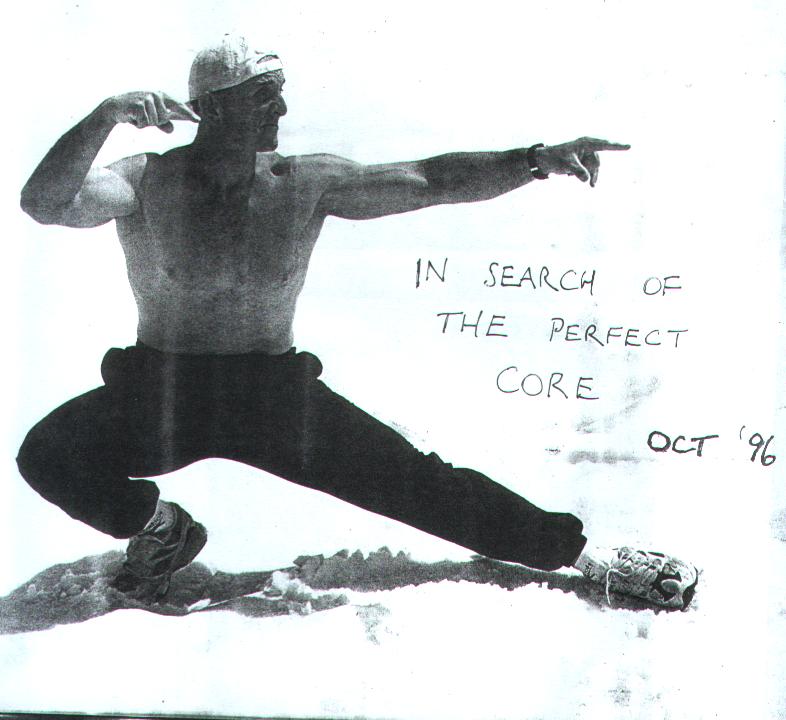
Bruce Connor the head physio at Essendon FC took this shot at Thredbo in 1996 and wrote the caption . We were studying the AIS facility in Thredbo for a camp for Essendon. So we went for a walk in the snow and voila “the famous core shot”.
Problem was that the next year Bruce and I went again but this time we decided to ski and I fell and ripped my rotator cuff to shreds. Thus these poses are now impossible given that skiing injury and a future career in bodybuilding ended prematurely .
Bruce is a great skier but I had only been twice and should have stayed in the gym negotiating at best a wobble board. It was October and the snow was almost gone. Only the “real” skiers were out there. I was slipping and falling but went again for another run and let rip. I definitely got my ambition mixed up with my ability. I lost complete control and flew into the air and put my arm out. Dumb. Next minute my arm was hanging and I was screaming. HA. The yeti! They had to gas me and haul me off the slopes and as they did I cursed Bruce Connor. HA. Anyway dislocated and ruptured cuff but the Thredbo disaster had occurred that year so really that put things in perspective. Bruce was driven to drink that night.
Anyway this is what is called functional core and adductor work out on the slopes. Sort of! But due to Thredbo my left delt shot is now a bit off. C’est la vie.
Malthouse , Old Coaches and Young Players.
Quote in Real Footy Coaching veterans pay the penalty
Dan Silkstone | July 28, 2007
“Malthouse, who turns 54 next month and has coached three clubs across three decades, remembered that in 1984 he coached at Footscray alone. Now he commands a football staff of more than 20. Still, he says, he can communicate well with young men such as Scott Pendlebury and Dale Thomas.”
Have young players in the AFL changed? Do old coaches not have the ability to communicate to young ones? Why did Hiddink at 60 have such great success?
People in 1754 were much the same as now. They ate, they argued, they cried and they had egos. That young people are soft or have changed totally is a crap argument. Life is very tough now. Circumstances have changed and kids do want more variety and employment choices but what i am talking more about is psychology not sociology. There are changes and coaches have to be aware of what this generation wants for the future but emotions and psyche and ego. Nah………..Have people from 1971 changed so much to people now.? What has happened of course are things like the information revolution and parents having to work a lot and so on. But the psychology of growing up and socialization is really much the same.
My father coached young kids and in fact the last kid he coached was Saverio Rocca in the discus. He was awesome with kids in his 60’s . Why? Because he made the whole thing enjoyable and progressive and didnt overtrain them. But still he wanted results and he got them.
What has changed in the AFL?
Specifically what has changed is that AFL players play for a living. Probably only since 200o really. IE Many players didn’t work before that but still didn’t need to be at a club 24/7. Now they get to work at 8am and leave at 6pm. They interact and eat with their coaches. They see them all day and realize they are human becuase of that. In fact this is a worldwide trend. Rugby Union went professional in the late 90’s. Soccer was all over the place til the 80’s and 90’s.
It wasnt in the 80’s. Even the 90’s. Training would start late in the day and one could almost do a full days work. Then get to training and walk into a meeting and cop a “roast” from the coach. Train. Go home and back to work for the day or university and switch off and get “kudos” or simply interact with the real world. Have lunch with a friend and “spray” the coach. In the main a young mans “persona” often was not totally linked to his sport and there were outlets. The player simply expected to go to training and cop a belting both in the rooms and on the track and so often just created a veneer.
In the old days ( early 90’s!) the player would leave the club at 8.30pm and buy a drink on the way home and just shake his head at what the coach had said. The coach would call them the next day and explain the roast and see you at 5pm tomorrow.
But now there are so many pressures. Add peer group pressures because in sporting clubs “winners are grinners” and there is a bit of “peer group” follow the leader stuff. So in a full time environment if you have been belittled and somewhat ostracized then sometimes others do the same until they see a different “nurturing” attitude emanating from the leaders. Its called “keep your job”.
I saw the transition from the VFL to the AFL. I started in AFL at 32 from Athletics and so was not a football person and what I saw amazed amd amused me with regards to a coach having the right to abuse and berate people. Didn’t make sense and still doesn’t. Hard nosed home truths are ok. IE ” You didn’t do what I told you to do etc ” or even an animated 3/4 time address that “rams” home what has been and hasn’t been done to an individual. We all like honesty in the end. And yes the coach is allowed to swear!
For those directly involved, the AFL scene is a workplace and an environment where young men grow up and socialize. That is what changed. Professional full time sport is very new in the worlds history as we know it. Of course I dont know how the gladiators were employed or the spartans , but I presume there was a big dropout then so we are talking World War 2 onwards here!
These days coach has to be aware that 30 minutes after ripping a player to shreds he has to eat a sandwich with him in the canteen and talk about politics or family or anything. Player might just look at him and think “f&%k off”.
Sure a few things have changed in the world but I think much more has changed in the AFL. Maybe just as an example 15% the world and 65% AFL since 1984.
Coaches that are “infected” by the past ( ie VFL and suburban footy) often struggle to realize they are just at work. And so age is not the variable here. Of course most coaches in all sports probably peak in their late 40’s? Not 60’s. But that doesnt stop a 60 year old coach knowing how to manage a team. Just like it doesnt stop a 31 year old athlete winning a gold medal. Just doesnt’ happen as much. Games will be won and lost and only one club wins the flag and I dont think a coaches rantings and ravings will have hardly anything to do with it whether young or old.
Volleyball and Development
Motor Structures in Female Volleyball Players Aged 14–17 According to Technique Quality and Performance. Ratko Katic Coll. Antropol. 30 (2006) 1: 103–112
volleyball-development-study.doc
This is a good read but as usual is just a study on one small group of kids. Not the written word. The problem that occurs is that people read studies or books or websites ( or blogs HA) and believe what they read. Belinda Gabbe presented at the AFL hamstring conference Sept 06 and explained that the only real study that might be relied upon is a cohort study. Thus one would have to get the whole AFL and get half the players to do programs used for Hamstring injury prevention and the other half nothing. Then one simply has to let them go and for example 5 years later check the statisitics. Unethical, impractical and won’t happen. Other studies are called case studies and cross sectional studies and can be very useful but may not be scientifically validated. So when you read these research article or anything I write, take it in and store it away for future reference. Thats all.
ANYWAY ONTO THE STUDY:
There were 2 age groups 14–15 and 16–17 . The study pinpointed 2 groups. Those more efficient at the net (explosive strength + agility) and those more efficient in the field (psychomotor speed + agility). Also some stats were provided as possible benchmarks for varied qualities (elite) female volleyball players aged 14–15 and 16–17.
Tests used for explosive strength assessment
1. standing long jump 2. standing vertical jump 3. approach vertical jump – jump both legs after volleyball 3-step approach 4. throwing medicine ball from supine position – 1-kg medicine ball
Tests for agility assessment ( should be change direction!)
1.6mx6m run – Change of direction test 2. 9-3-6-3-9 m run – Another change direction test. 3. T test 4. Hexagon test: Jump test
Tests for assessment of movement frequency ( reads like a dance to me!)
1. hand tapping 2. double hand tapping 3. foot tapping 3. foot tapping against the wall –
6 variables were used for assessment of volleyball technical efficiency
1. service 2. serve reception 3. setting 4. spike 5. block 6. field defense
*They also ranked the girls for volleyball qualities and also team qualities
MY GENERAL SUMMARY or INTERPRETATION of this study
I have copied the conclusions below from the article. From my perspective relative to development and relative to many team sports what this article says is that at 6 to 10 kids should learn the sport and all its skills and also grab the window of opportunity and play fast sports and do activities that assist co-ordination. At 10 to 12 ( before puberty?) work on change of direction and agility with training and varied sports and specific volleyball training and maybe throw some medicine balls around and get off the ground with sprints for example. Not advanced plyometrics! Then at puberty onwards do some light strength work and related basic jump and jump technique training to enhance volleyball skills. Again general work that creates a base and complements volleyball skills. At 14 to 15 work hard on most aspects but still work more on change of direction and general strength needs and individual needs. Then at 15 to 17 power them up and speed them up. If the girl is mature and has a good training age then work hard but of they are down on qualities go back to square one and get these “topped” up. So ideally at 17 the base should be set and they are on their way. Ideal! This is one way I would interpret this study?
ACTUAL CONCLUSIONS FROM THE STUDY
*at age 9, selection should be based on psychomotor speed and coordination on solving complex motor problems. These motor abilities will ultimately limit
elite game performance: psychomotor speed by facilitating technique performance, and coordination and/or motor intelligence through faster motor learning and efficient solution of game situations;
*at age 11, selection should be based on coordination in terms of agility and explosive strength facilitating performance of basic technique elements, e.g., service and serve receipt;
*at age 13, selection should be based on explosive strength and agility that facilitate performance of techniques, e.g., block and spike;
*at age 15, selection should be based on specific motor abilities that are primarily related to body height, strength and spike precision, i.e. specific explosive strength and specific agility-mobility; and
*at age 17, selection should be done by evaluation of all specific motor abilities, especially specific speed and specific agility-mobility, enabling elite female volleyballers to efficiently manage all possible game situations and facilitate their technique performance, especially those in field defense
 loris bertolacci