Razor Curls Exercise . Why use them?
The razor curl really came to my attention when this video was posted of GWS AFL player Dylan Shiels. It went viral. It does look impressive. Before that I had never seen it. And remember when I trained in Europe in late 70’s we were doing Nordic hamstring lowers then. With a friend in 1984 we built a glute ham machine at Preston Athletics Club. I read everything then and now. Maybe the razor curl was used for hundreds years? But I had not seen it.
When I searched Google Scholar the first paper I could find on this exercise was in 2009.
Link is below. Nothing before that. Could be wrong.
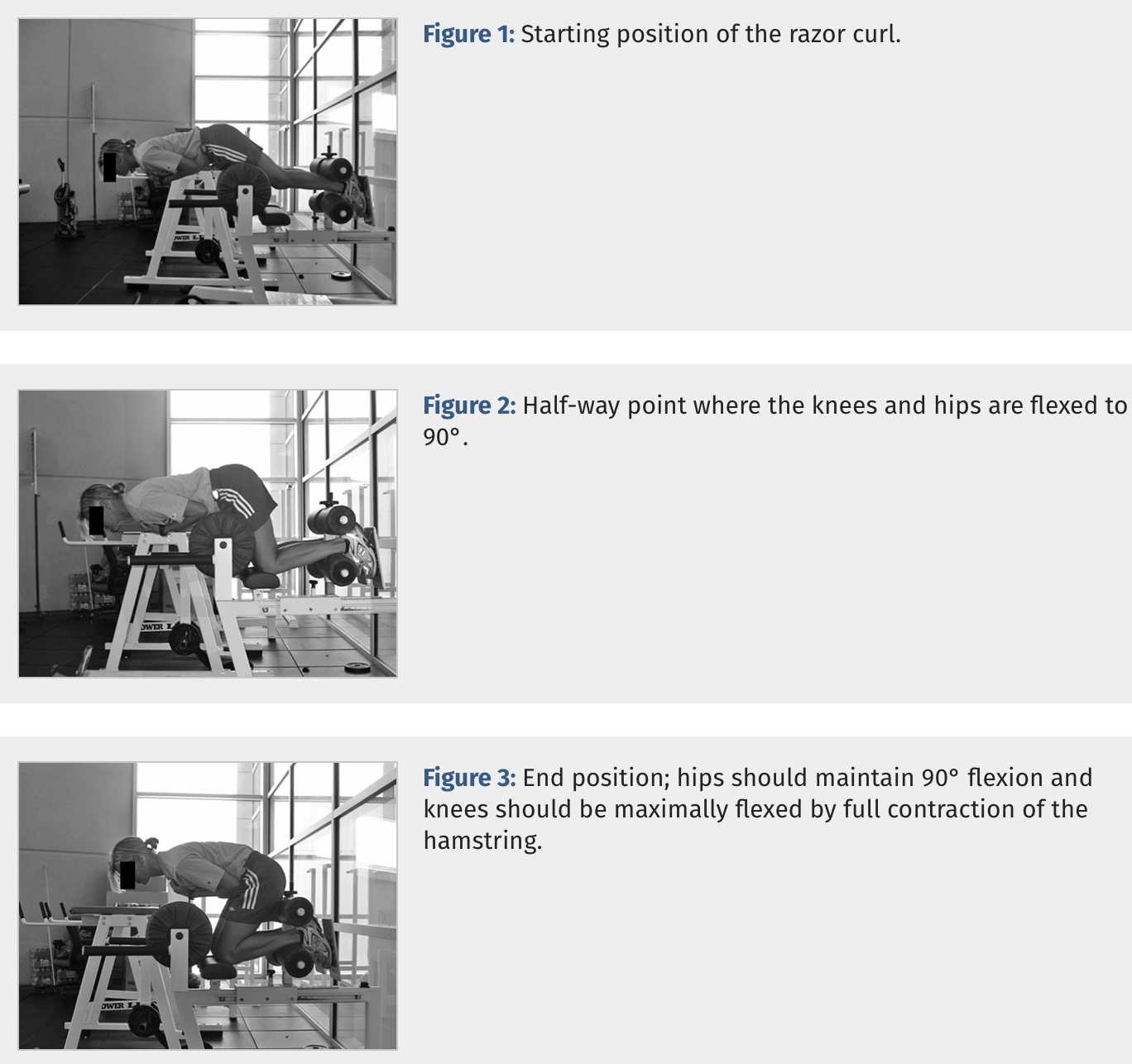

Interesting how that words “functional” and “real world” crept into their abstract. Quotes from their paper below.
“However, if one wants to fully train the hamstrings functionally, one should focus on the razor curl. Due to its functionality, the razor curl is designed to increase hamstring contractibility by placing the hip into flexion.”
“More importantly, the razor curl provides one a training method of eccentric hamstring contractions and simultaneous dynamic hip movement. This provides one with a “real-world method” of hamstring functional training in the athletic position as opposed to the prone hamstring curl.”
Below is a further summary from this study. To be honest I could not summarise in my words, what they were getting at. So just planted the excerpt here.
“The razor curl places the hip at 90°, thus placing the hamstring on stretch for optimal production of knee flexion. In addition to placing the athlete in a functional position when performing the razor curl, one is also training the hamstrings eccentrically at the knee. Training the hamstrings eccentrically in a position that also provides for gluteal activation provides the athlete the chance to develop neuromuscular conditioning in the functional athletic position. The net effect of this neuromuscular grooving is to provide the athlete the opportunity to place the hip and knee in the optimum position with hamstring activation to protect the ACL.”
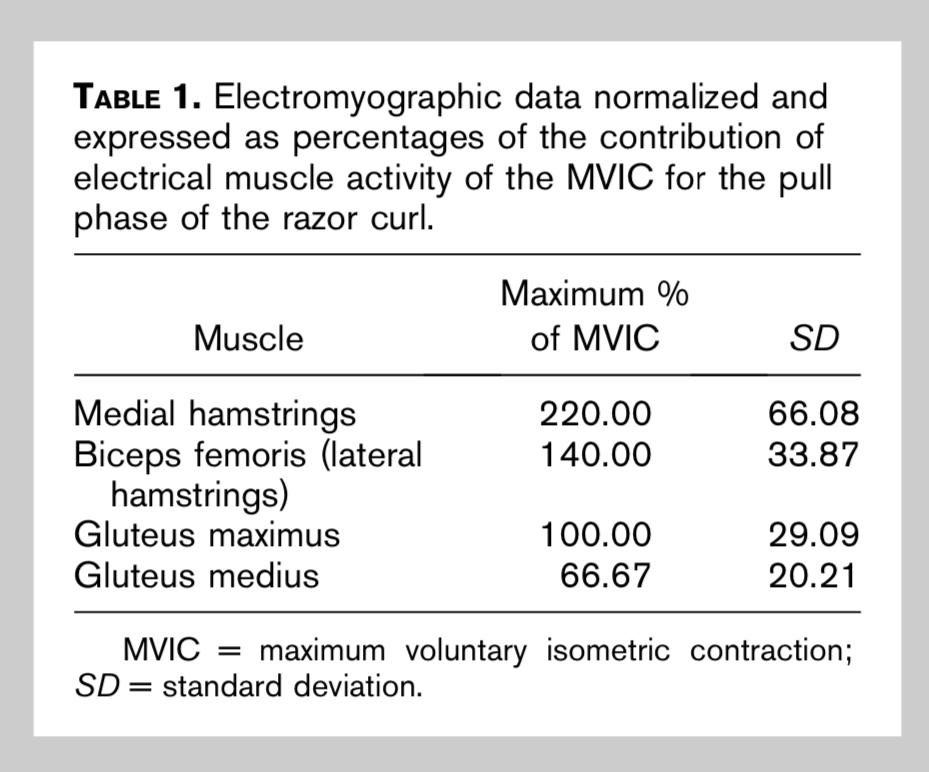
In fairness to the authors whilst they talk about functional positions, their results do show that medial hamstrings were targeted more in this exercise. And thus they go on to talk about the relevance of medial hamstrings (thus this exercise) in ACL rehabilitation and prevention. Table is below. Interesting though if we fast forward to social media now, this exercise is posted often as a crucial one in hamstring injury rehabilitation and prevention. But we all should know the relevance of biceps femoris long head in hamstrings in sprinting. So that’s a clue to the rest of this blog article.
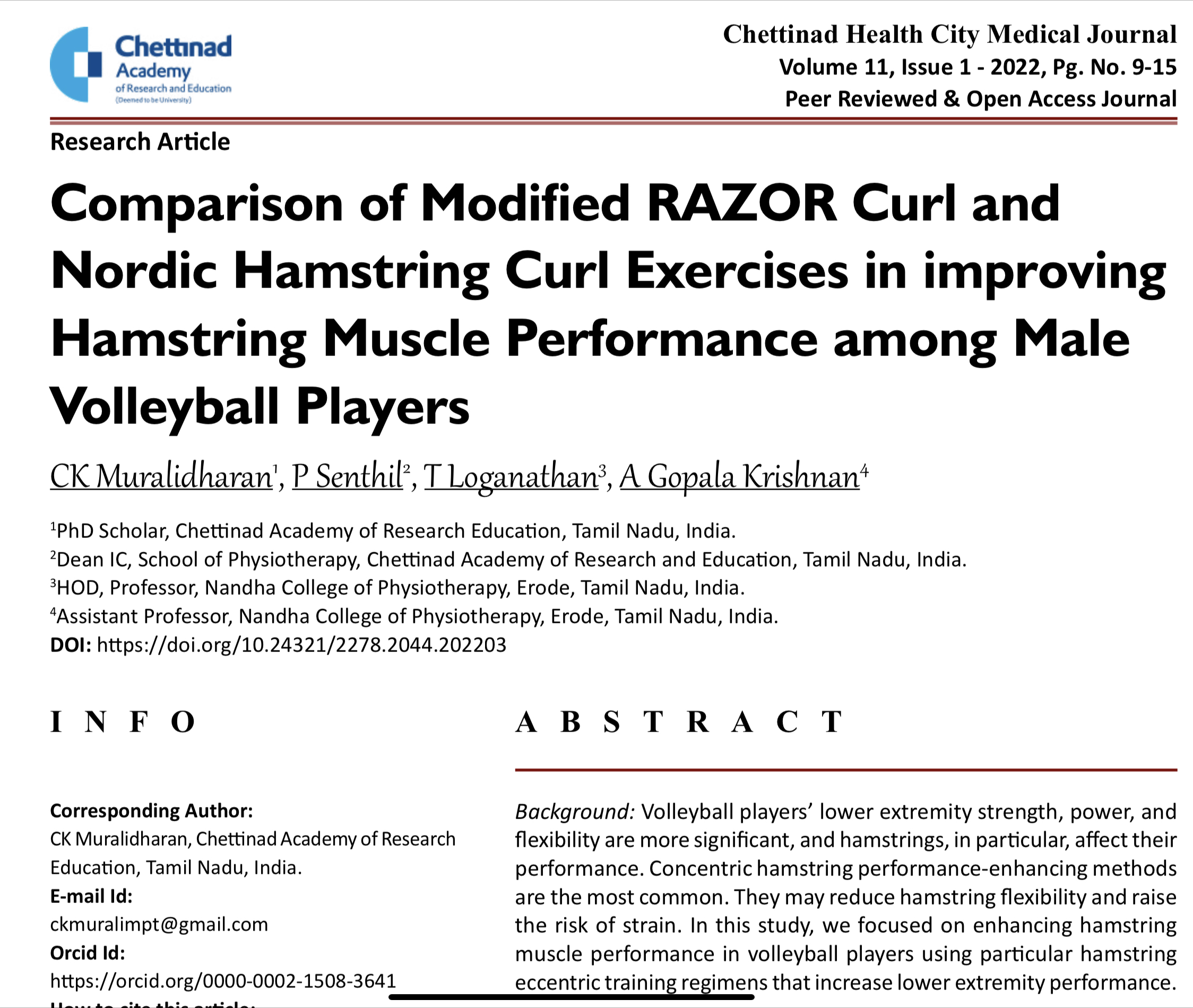
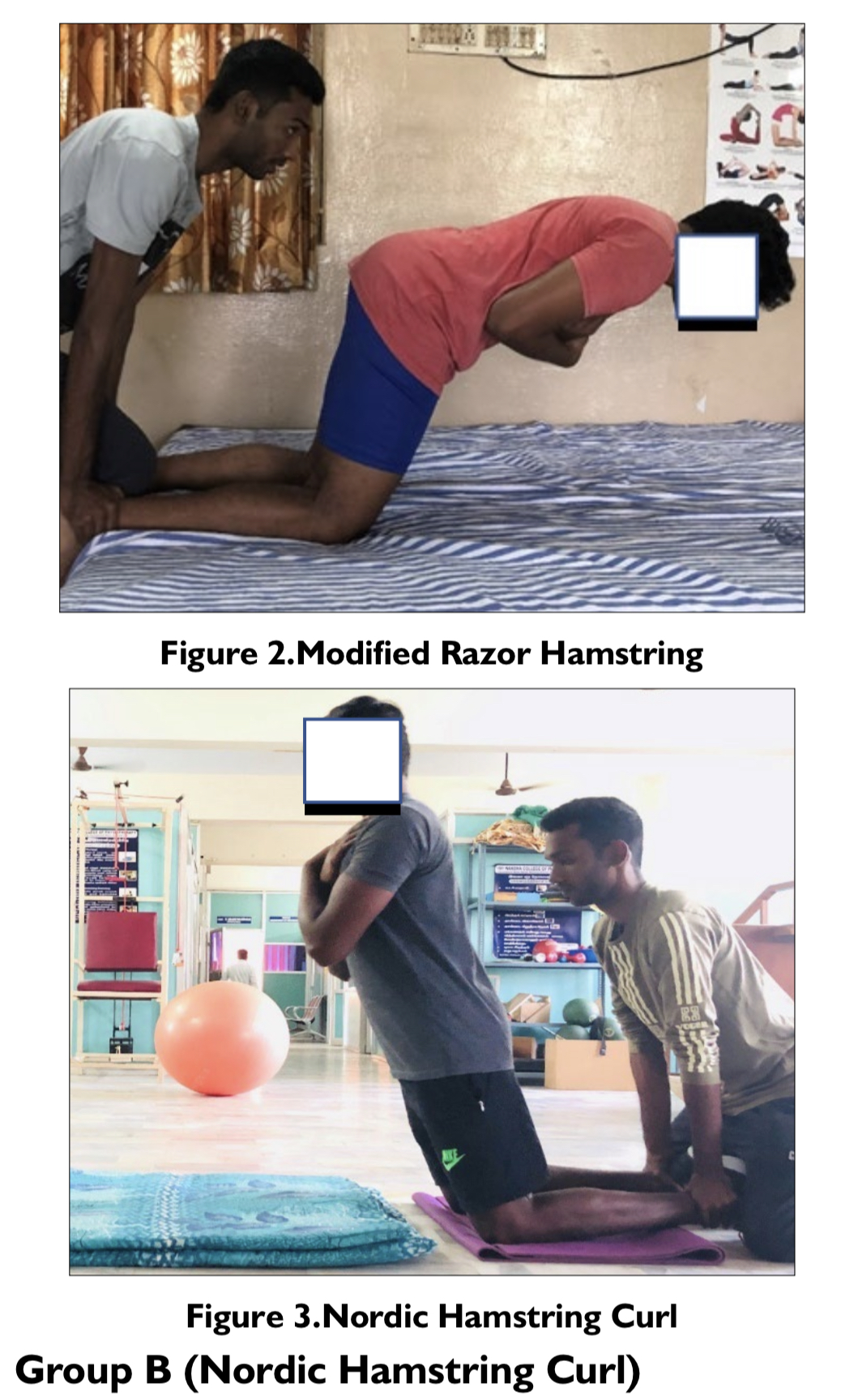
I found this interesting study from India. It compared the modified razor curl (assume a harop curl nowadays) with the conventional Nordic hamstring. It looked at performance tests. Maximum lifts, 40 yard dash and a back arch superman test. Their conclusion was that the Nordic was best for lifting and sprinting tests whilst the modified razor curl would be better for core strength. Below is their conclusion:
https://medical.advancedresearchpublications.com/index.php/CHCMJ/article/view/1066
“Finally, it can be concluded that if players need to improve strength as well as support muscles such as longissimus and multifidus, modified RAZOR curl was highly recommended. In the case of players who wanted specific power and strength training, Nordic hamstring curl was the perfect option.”
I am not going to comment on the robustness of this study. But it starts leading us to some questions. Obviously the razor curl is different to the modified razor curl. Once you have flexed upper back to 90 degrees in modified razor then hamstrings are contracting as one pushes out. Suppose my question is why do the razor curl and harop curl? If there is a “core” component how useful anyway? Often modified razor curls are presented as a progression to nordics. But we know there a a huge number of regressions we can do with nordics. Using a Swiss ball in front, bands etc.

An extension of the 2009 paper on the razor curl by the same author a few years later, was promoting the modified razor curl (harop curl) as a suitable torso or core exercise. Link is below
https://www.ncbi.nlm.nih.gov/pmc/articles/PMC3273882/
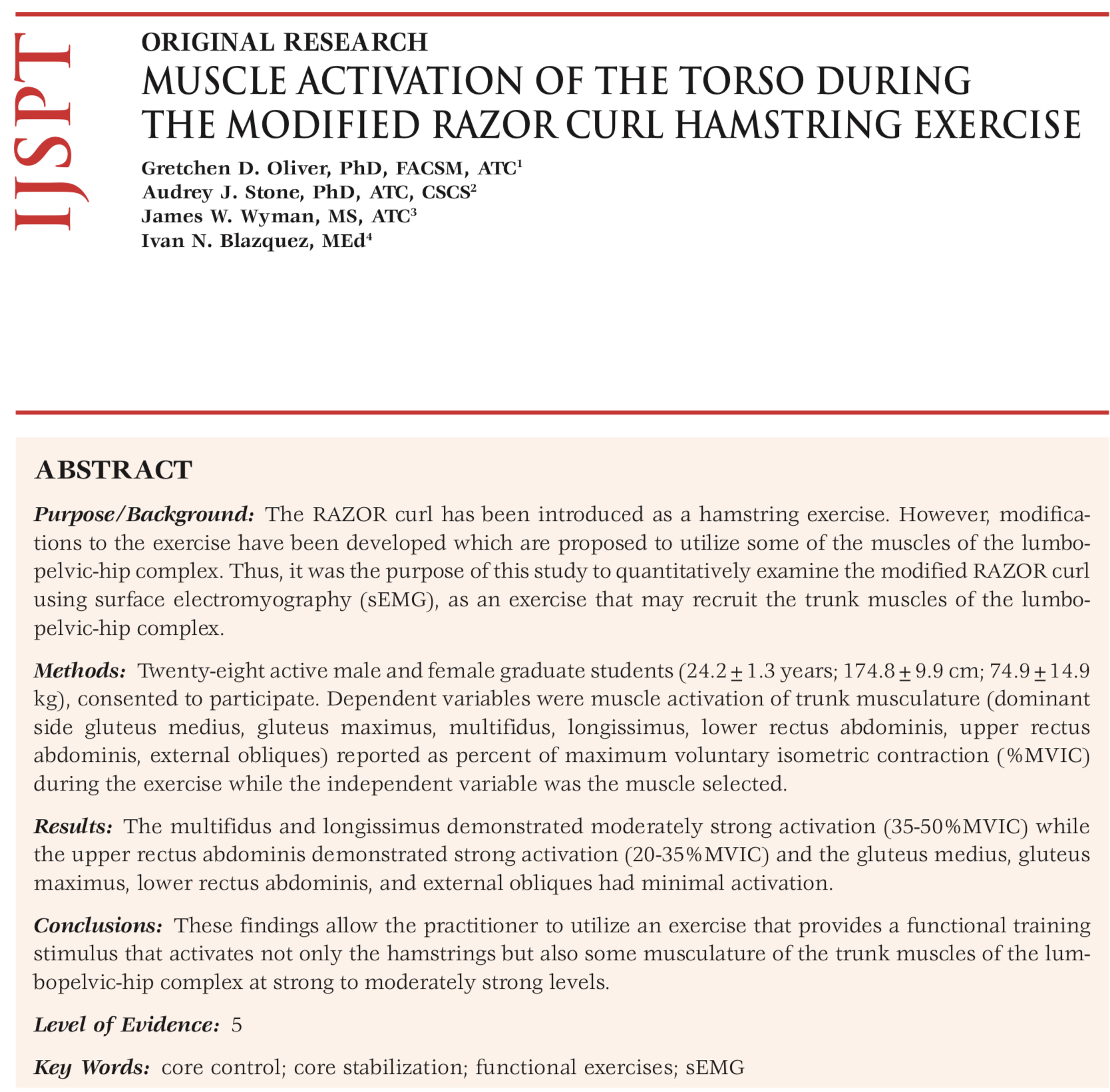
What is interesting is the small “get out clause” in this paper where the authors suggest this is only a low level torso exercise. Quote below from paper.
“The results of the current study must be interpreted with caution when determining if strengthening of the trunk musculature could occur during perfor- mance of this exercise. Although the multifidus and longissimus demonstrated moderately strong activity and the greatest of the muscles examined, the level of activity produced by the modified RAZOR exercise may not be sufficient to provide a muscular strength- ening stimulus. Previous authors have reported that muscular strengthening requires 50-60%MVIC.33. “
After this there was not much evidence on the razor curl or harop curl to be found. But certainly given the funkiness of the movements, lots of claims on social media about the effectiveness of these exercises for hamstring health. Like all exercises, of course already these exercises are ok. They do something it seems. But given the lack of time athletes have in the gymnasium, can we get better bang for buck?
Fast forward to 2019 and a recent paper looked at the effectiveness of the razor curl versus other hamstring exercises. And the methods used seemed more robust than previous papers I mentioned.
https://pubmed.ncbi.nlm.nih.gov/30629773/
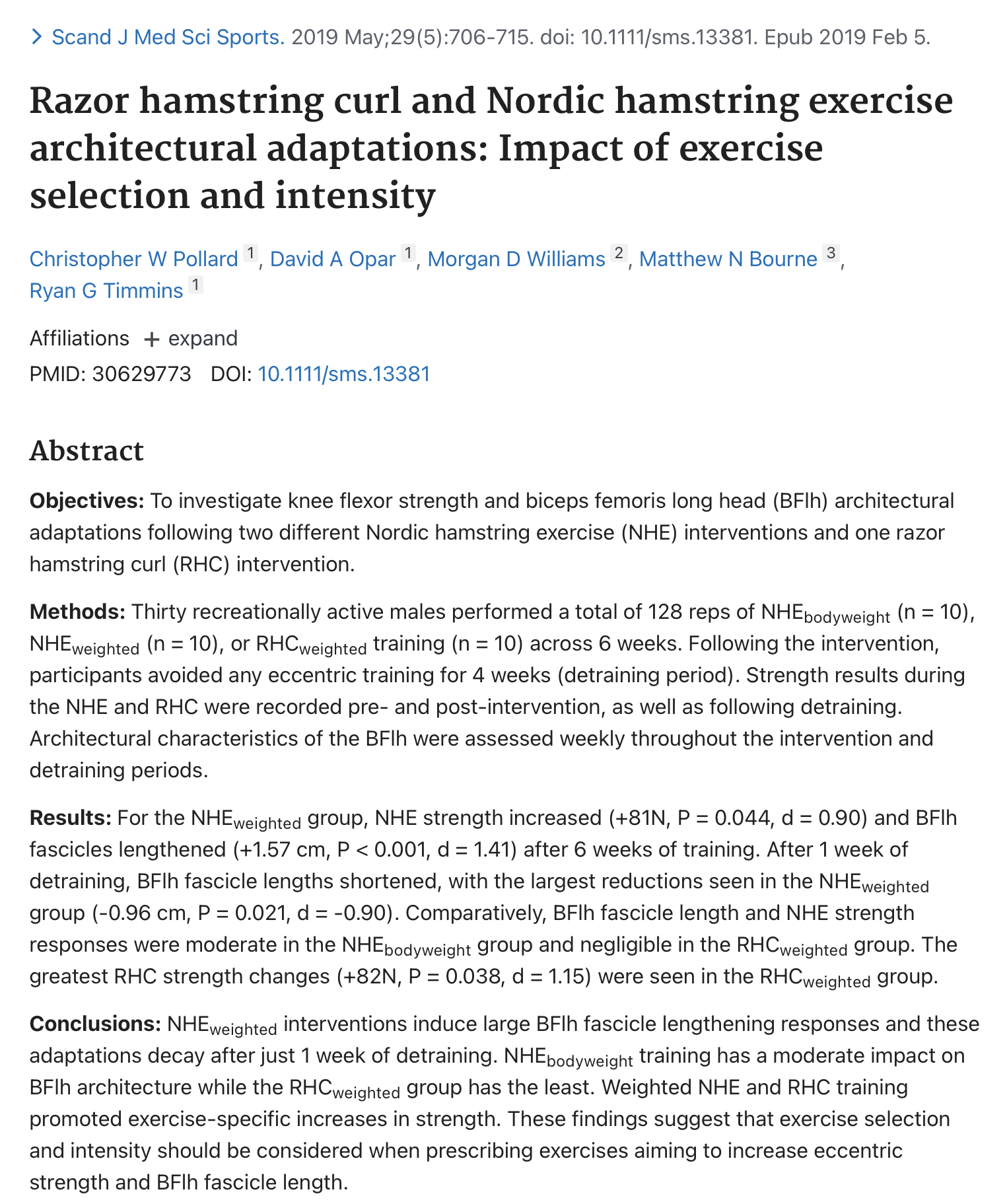
So it seems that the razor curl as researched in this paper has the least impact on biceps femoris long head! So this would seem a pretty important finding, Why do it for hamstring injury prevention or rehabilitation? And it seems the modified razor curl is a low level core torso/exercise. Below are some conclusions from this paper on the RHC (Razor Hamstring Curl).
“Finally, the RHC as a preventative exercise for HSI may have limitations, given it induces negligible BFlh architectural change or increases in NHE strength.”
“However, as there is no evidence to suggest that improving RHC strength may offset the risk of future HSI, it remains to be seen if the implementation of this exercise has its place in injury prevention practices.”
I couldn’t find much else searching Google Scholar on this exercise. Correct me if there is. But of course. Social media is awash with razor curls and harop curls and big claims. Maybe a few back extensions superset with a few Nordic hamstrings or eccentric leg curls might be a better use of S&C time for an athlete?

So conclusion? Of course doing these exercises might help a bit. But be aware that (so far) there is no evidence that they do what many on social media claim. And many on social media create their own jargon with words like proximal and distal and isometric clouding the posts. But the current level of evidence is tiny, with the most recent paper I could find putting a question mark on the exercise for hamstrings. They might just be another exercise that has crept into exercise selections. But an exercise were evidence (up till 2023?) does not back up social media hype. And remember. Despite all the hamstring gurus out there (and increase in exercises) we have not seen decreases in hamstring injuries. My opinion is there is too much emphasis on trying to find the “holy grail” exercise as against keeping it simple. IE; do some nordics/eccentric leg curls/back extensions/RDLs bit of hips etc. But then focussing more on multi factorial issues surrounding running, mechanics, dosages and proper objective return to play running programs. Seems a disproportionate percentage of time spent on the exercise side of this injury.
No comments yet.
 loris bertolacci
Leave a comment