Are Intermittent Fitness Tests like YOYO Redundant?
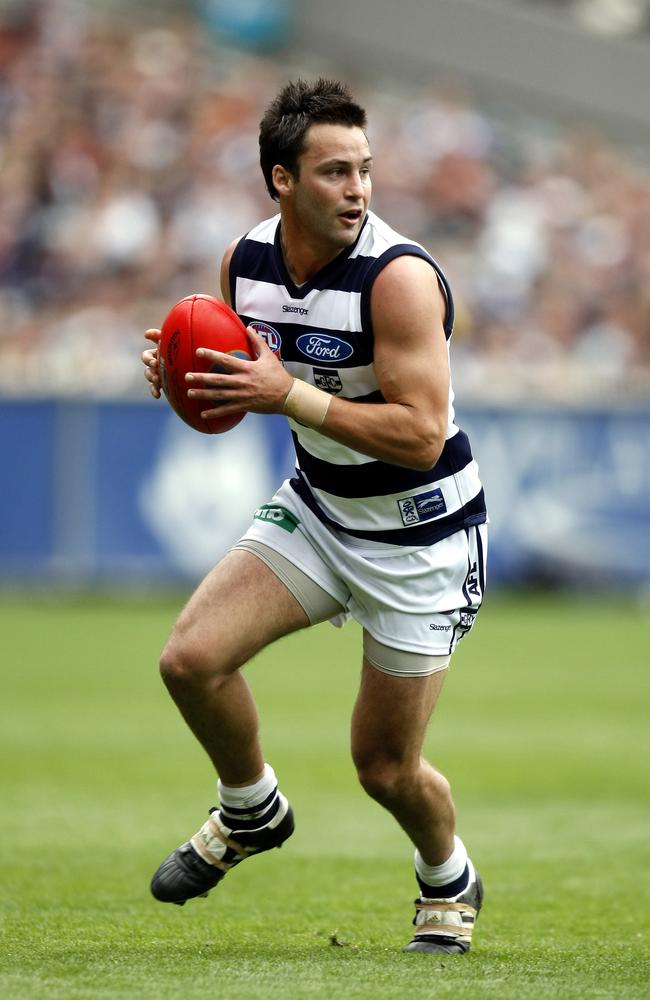
I once read about a term called the “Queen Mary Effect” in athletes. This refers to a player who has adequate or even good aerobic fitness but struggles with change of direction, resulting in poor performance in tests like the beep test, Yo-Yo test, or any intermittent fitness test involving frequent changes of direction. Jimmy Bartel was an example of such a player. In 2023, as a young athlete with huge potential, his coaches deemed him unfit during competitive games, despite his promising performances. Subjectively, this conclusion was supported by his fitness test results: a beep test score under 13 which was poor. Despite a 3km time of well under 11 minutes, and a VO2 max in the mid-50s—sufficient to suggest he could develop the “repeat speed” required for his sport. Additionally, his 20m sprint times were 2.99 and 3.02 seconds. He was not “fast” but in a straight line did ok.
The fitness staff noticed the coaches implementing a lot of shuttle runs and additional running drills, which raised concerns. We decided to conduct a more detailed assessment.
We introduced the following tests:
- The NFL 5-0-5 test.
- A modified 180-degree change-of-direction test (left and right).
- Vertical jump tests.
- Multiple single-leg hop tests.
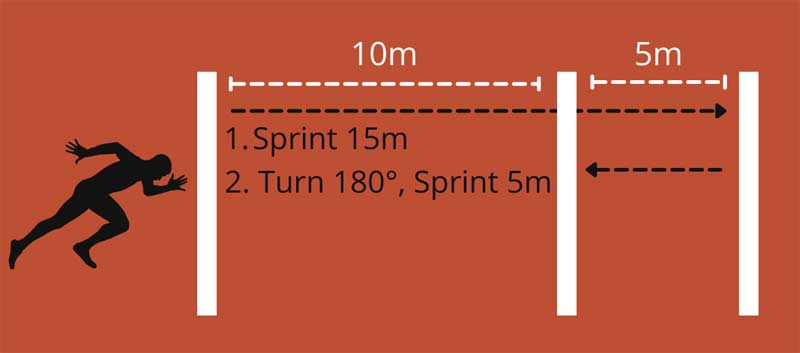
The results revealed significant deficiencies in leg power. His single-leg hop test results were well below norms, and his change-of-direction tests were poor. In summary, he struggled with changing direction efficiently.
This explained his poor beep test performance. Every turn during the test resulted in an energy leak, and he displayed inadequate acceleration after each change of direction. Cumulatively much slower each 20 meter segment. Plus more fatigue due to lack of eccentric efficiency.
After six weeks of focused power training, we re-tested him. His beep test score improved to over 14, and his in-game performance demonstrated noticeable improvement. Importantly, his VO2 max and aerobic threshold hadn’t changed, indicating the improvement was purely due to enhanced power and change-of-direction ability.
This experience led me to question the relevance of intermittent fitness tests like the beep test and Yo-Yo test for team sports. These tests seem to have too much “noise” to accurately measure fitness.
Pure aerobic tests can tell us about an athlete’s base capacity, while power tests provide insights into their ability to change direction and apply aerobic capacity effectively in specific scenarios. However, the issue arises with outliers:
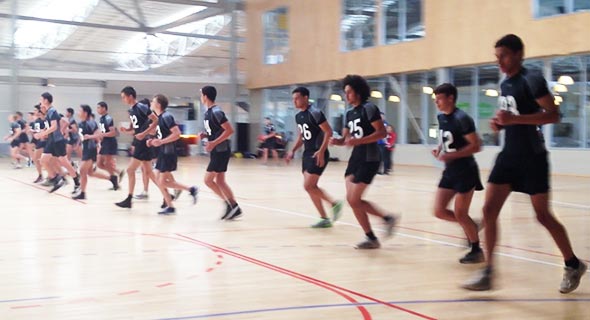
Players with strong aerobic fitness but poor change-of-direction ability often perform poorly on intermittent tests due to inefficiency in turning.
Conversely, powerful players may mask their poor aerobic fitness by excelling in change-of-direction tasks.
Players who sit in the middle likely have intermittent test results that correlate with their aerobic fitness.
My estimate is that a minimum VO2 max of 52 is required to play AFL effectively. By combining aerobic fitness data with power and change-of-direction tests, we can gain deeper insights into an athlete’s profile.
However, I question the necessity of these combined tests, such as the beep test, Yo-Yo test, or 30-15 Intermittent Fitness Test, given their variability and potential lack of specificity for team sports.
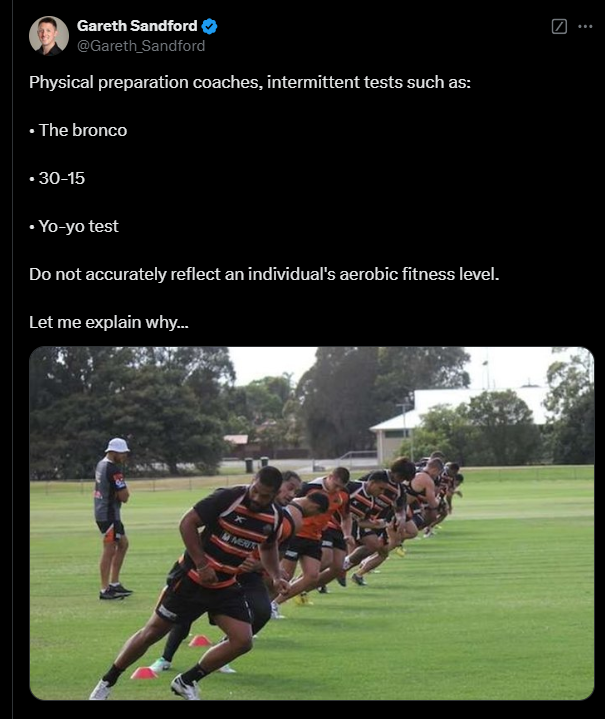
Gareth Sandford has been doing a great job bringing these issues into focus in training and testing team sports.
https://twitter.com/Gareth_Sandford/status/1671534198945988609
No comments yet.
 loris bertolacci
Leave a comment