SKILL BASED CONDITIONING. IS IT ENOUGH? NO!
Small sided games and fitness through games has really made its mark in team sports training. Lot’s of work filtered through from Hockey and other sports and in AFL we saw the Adelaide Crows pioneer this approach. Nevertheless they used other means (for example ergometer work) to supplement fitness, but less formal running. But has their high injury rate occurred due to high fitness levels and poor motor patterns? Who knows? This is a bad mix and at the base of my discussion. This approach has filtered through to many sports and recently we saw a research article by Gabbett on Volleyball with juniors. Obviously “bang for buck” in simplicity is far greater when things can be combined but my opinion is that there is a downside to what seems a simple solution to fitness. Yet I have seen many problems with this approach.
We have seen an explosion in sports science in Australia and a huge influence on sports such as cycling and rowing for example. Team sports have achieved enormous benefit due to sports science, with areas such as load management, heat management, hydration and many other areas receiving enormous backup. Huge factors and load management has been a big one with GPS and databases etc.
Sports such as soccer are now creating skill based TID schemes where kids are encouraged to play heaps of games and learn lots of skills early and then they are selected later on from a larger pool of skilled players. Simple.
But we have direct evidence that the relative age effect destroys the careers of many young players and only the gifted younger ones come through (and in fact succeed more often) coupled with kids with advanced maturity that sneak through. So many good kids are left behind. That is kids that are born early and who survive due to talent, do well at elite level. On the other hand the “bruisers” with no talent also do well as well as older kids. So many young (born early) players are lost and this is mainly a physical factor due to maturation and/or training.
And look at Tennis. We have a massive generation of players whose parents have mortgaged their houses for coaching and yet no result so far.
Sports Science has been little assistance to track and field. The scientists would say that the coaches do not want to listen. But my opinion is that the sports scientists have little to offer because very few really know how to create advanced athletes. Sports Science is awesome at telling us how to manage a player in Malaysian heat but has little idea how to propel someone over 2 45.
In team sports like AFL we simply aimed at the average. One needs to be good at many areas. Intermittent sports require a broad long term base of conditioning and good acceleration and a sufficiently developed aerobic system to assist repeat efforts. Average to OK in the gym and average to OK in power. All achievable and in the end injury management becomes a key as does talent. My experience in all these team sports is much the same. One usually does not need to create super athletes. But if a team has a core of players who have talent and also have developed all their fitness skills (running/jumping/change of direction etc) then that team should always beat a mob that can play and are fit but lack “fitness” skills. Always the same principle. All things being equal, one factor will make the difference.
Getting back to tennis, my opinion is that strength and conditioning and fitness are simply massive factors why we are falling behind in many sports. And this needs to happen early. Puberty. And by then kids should be fully developed in all facets of running and jumping and change of direction and also have a broad base of conditioning. What we see in OZ is a huge number of skinny kids with good aerobic qualities and one sided bodies coming up against explosive “Europeans” and now Asians. Forget what happened 30 years ago. No one played tennis.
And with all due respects let’s not really consider many sports in OZ like netball and cricket and AFL because they are not played on the world stage. Our female basketball improved when they started all going OS. So there is nothing to compare here. Even Rugby League is limited in exposure. Rugby Union is only now starting to go PRO all over the world and we will see the effect of that in ten to twenty years.
In Athletics we do not have coaches for kids. Kids are not taught. There are other problems but it is difficult to change bad habits. In AFL usually paid and competent fitness personnel spend 2 to 3 years fixing up massive deficiencies in players from 17 to 20. And that works and we see a reasonable product by 21. That’s ok for footy and then add some skills based games for fitness and VOILA …Fit and at 25 yo the team wins games.
We have seen the push to work a lot on agility versus change of direction. But my experience was that the freaks (e.g. Gary Ablett) had it all. Ability to change direction, balance and then vision and skill.
In Volleyball all I see is skinny little frail kids jumping around and getting fitter BUT reinforcing very poor “fitness” and neuromuscular habits. Once ingrained hard to change. And Volleyball is a real sport. Played everywhere. Lot harder to succeed in than cricket and netball and AFL. So strength and conditioning at an early age is now in my opinion an absolute priority. We must have players ready at 16 to 18 to explode on the world stage. In AFL they usually cannot squat with a broomstick at that age and it doesn’t matter. One has time in the cloistered environment of AFL. But in tennis and athletics and volleyball and soccer, there is no time. Be good early or perish. So know how to play the sport, make decisions on court, do the clean and jerk and bound through the roof. Not balance on a swiss ball.
I have spent 15 sessions with an elite junior soccer team (12 yo) and have done 45 minutes a week of running technique and core and balance work. The results have been great and now many players are starting to challenge other players in state teams from other clubs. The coach says they are more explosive, balanced and change direction. Add skills and decision making and a talented player assumes their right position. And the young boys like doing it as long as they are not being flogged and they are learning and having fun.
The skills based approached in my opinion can be lazy. Simply get heaps of kids doing the sport and see who comes through. Chuck them a ball and let them play. Of course they will get fit.
It is obvious that one has to learn the sport early and learn to make decisions. We know that multi lateral development is the key at least till puberty. But the missing link is strength and conditioning and movement education at an early age. And core development and balance.
Of course if I get kids to play all day at 100% pace in the backyard chasing dogs and jumping fences they will improve in their vertical jump and 5m tests. But we need to slow down and realize that life aint that easy, and ask the question why we struggle in so many sports.
I think sports science has to slow down a fraction and ask the question “Can I get a male volleyballer to vertical jump 95cm?” or a tennis player to explode sideways and drop their centre of gravity and smash a forheand back to NADAL. Having good salt balance in a drink at Wimbledon will not help if you cannot get to the ball.
Let’s remember that the best coaches are ones that combine ART and SCIENCE.
I love sports science and in fact if we can attend to the strength and conditioning issues at a young age and have skilled kids ready to go at 14 to 16 we will dominate the world. My opinion.
So in summary.
Do everything in development. Zero shortcuts.
And forget non-international sports and non eccentric sports (circling/ rowing, swimming, kayak etc) when comparing and or using sports science.
Ciao
Loris
Brisbane Lions and Development in the AFL

Here you can see the changes that occur in 2 to 3 years. Whilst Brisbane had a good average age in 2005 their distribution was poor with too many young players and too many old and no warriors. In 2008 we see a team that is too young on stats to win a flag but developing perfectly with a core of players coming through and when that BELL CURVE or PEAK hits 25/26 and 100 games they should be very close. So this seems to be the model required for success in the AFL unless one is lucky or simply has heaps of older or younger champions. Geelong fits this model perfectly and in 2004 had too many young players. So this type of analysis and planning is the key it seems plus add good players and all the other factors mentioned in the previous article on development.
Development in the Australian Football League AFL
I recently listened to Kevin Bartlett and Peter Daicos on SEN talking about development in the AFL. Daicos spoke about the importance of development. It was interesting but still missed the real factors involved in long term development in any sport really. In the end the discussion focussed too much on one or two years.
The AFL is a sanitized and manipulated sport. And so one cannot buy teams it seems. We have seen teams try to mix and match in the past few years and develop on the run by recycling some players. This simply has not worked. Most teams that have won flags recently have stuck with a core of players and worked through almost 10 years of development. West Coast Eagles started a restructure in the late 90’s with their list. Sydney had been though a lengthy period with a mature group before crashing through. Port Adelaide the same with a very mature group. Many years of pre seasons and heartache. And more so waiting till the core group was an average of 25 to 26 years of age with really good proven veterans and quality young players mainly from 21 to 25. Thats it. Add to that what seems to be a need to have some money floating aound to service the team with needs such as medical, fitness, massage and other critical needs. Clubs such as North Melbourne have certainly not delivered given they simply have not had resources in my opinion and yet have been thereabouts. I always use a seemingly trivial area such as massage to point out the need for resources. I am sure the power clubs have massive budgets for massage whilst North would have very little. This is not a 1% but may be a .25%. All adds up by finals.
Time and time again we point at reviews or culture or other totally nebuluous and subejctive concepts. If the team has a core of hardened players that have an average of 6 pre seasons and some finals experience one has a chance. If they average 100 games of AFL footy the chance increases. If the club is well financed the chance increases. If there is some relative and current political stability then the chance increases. We have seen recent examples of clubs winning flags with supposedly poor cultures so I query that one.
We are talking about young men who represent these clubs, but with mature bodies. Every club has a leadership group now but someone has to finish last. If the club can get on a winning role then usually everyone is happy including media and supporters. Added to financial stability this helps . Then clubs make good decisions when in a positive frame of mind and the positive cycle continues. Teams that lose a lot usually meddle and overtrain inseason. More disasters. Young bodies. Old bodies. Stress. Crash and burn.
When teams are firing, bodies are mature, but still vibrant and fresh, less injuries occur. It simply is less stressful. And when less injuries occur there is less drain on the current list and so again less wear and tear occurs and the load is evenly distributed. So less injuries.
Without talking about the science of it all, there is no doubt that a positive frame of mind can assist the avoidance of injury and illness so the whole cycle becomes “virtuous” and one is on a roll.
It takes a glut of injuries or total political instability and some losses to upset this “happy” cycle. Does happen and recent events have demonstrated this. Or in the end your best players are too old and young players too young and there are no warriors in between. By 2005 this was Brisbane. And did Adelaide lose their opportunity to win in 2006 with an injury glut at the end of the season Maybe? But now they seem to have old players and young players. So do they make a decision to go into a long term development phase or do they keep trying to have a crack by mixing and matching given they are so weel resourced and well coached. Tough eh! And is the Bullodgs now reasonable well resourced and with a quality core gorup at the right age? When I did my consultancy on their ACL injuries in 2006 at the Bulldogs I can assure readers that their resources were light years behind those of Geelongs without elaborating. It was tough for the players I thought, after having worked at Essendon. Colingwood and Geelong.
So development means that over time players have pumped weights, run miles, made heaps of decisions on the ground, learnt their skills from coaches, grown up socially and been involved in a vibrant well resourced club. After all there have been some excellent cultures with clubs that are poorly resourced and they do not seem to win.
Remember it takes time and in the highly controlled AFL compettition, 9 times out of ten one simply has to get the best players together at a young age, train them properly for 6 to 8 years and make sure the business is ok. You won’t win with a bunch of 23 years olds or a bunch of 28 year olds and it seems you won’t win with a paupers budget. And this is the AFL not Premier League Soccer where the best can be bought so the AFL’s contolled environment allows for objective analysis.
And then those 25 year olds have to be good players with the odd star. And really the 22 games is the accurate reflection of development. The finals are a slight lottery. And yes other things have to be ok, But get long term development wrong and fight nature and forget it.
Simple. HA.
Loris Bertolacci
HAMSTRING REHABILITATION E BOOK
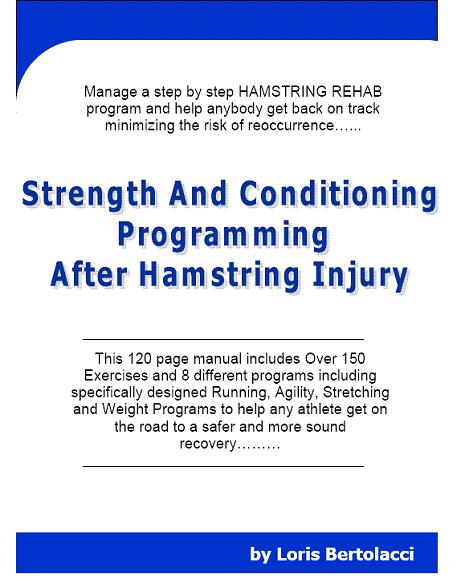
Available on my website now
Loris Bertolacci Site
http://www.bertolacci.com.au/LorisBertolacci/Welcome.html
This E Book is a complete resource for anyone that needs to devise practical programs for hamstring rehabilitation. It delves into the current research on this area to back up the programs.
This 120 page manual includes over 150 Exercises and 8 different programs including specifically designed Running, Agility, Stretching and Weight Programs to help any athlete get on the road to a safer and more sound recovery.
Section 1: Hamstring Theory
-
•Introduction
-
•Anatomy
-
•Overstriding and Hamstring Injury
-
•New Studies Implicates the Core in Hamstring Injury
-
•Other Muscles that Impact on the Hamstring
-
•Hamstring Exercises
-
•Why Injuries
-
•Trunk Stability and Hamstrings
-
•Different sports and Hamstring Rehabilitation
-
•So what do you do if you hurt your Hamstring?
-
•Healing Times and Rehabilitation
Section 2: Practical Section
Program Advice
-
•Sample Sessions
-
•Mobilization Sessions
-
•Running Sessions
-
•Mobility Drills
-
•Running Drills
-
•Running Sessions 2
-
•Strides
-
•Agility Sessions
-
•Weights Sessions
-
•Stretching after Training
-
•Plan your own rehabilitation
AFL. Grand finals, the draft, salary caps and fitness.
COPY THE LEADER?
Lets do what Geelong did in 2007 to win the flag? Maybe an emphasis on sports specific drills and tackling and actually training hard in pre-season 06/07?
Lets do what WCE did? Run more maybe seemed the message?
Lets do what Sydney did? More recovery/injury management processes and rotations seemed to be it.
Lets do what Brisbane did? Weights and strength seemed to be the message
Lets do what Essendon did? More sprints/buy spikes
After 2000 sprints coaches got gigs in clubs given John Quinns background in Athletics. They looked fast. After Brisbane weights coaches got more work. And so on.
What everyone forgets is that with the DRAFT/Salary Cup most will get a chance. Of course you have to seize the moment. But to say that Brisbane did more weights etc is crazy and quite the opposite WCE did run/run/run…..What is the key is to get a group coming through that is talented and develop them and hang on. Get the place chockfull of resources with massage and medical and fitness and welfare to assist the players. Geelong won VFL GF 2002/NAB Finals 2004/Prelim 2004/One point 2005/On the way in 06 then after RD 3 haywire. Now they have realized potential. Were the Kangaroos on the money this year but that 1% of less resource bit them on the bum? Who knows?
Geelong are well resourced due to their financial recovery and also had players with 5 finals / 2 NAB finals etc etc and an average of 6 years of development. Average age of 25.7 and 100 plus games and most in the 22 to 28…That seems the basic need. And they must have demonstrated they can play in the past.
In a free trade system they just buy teams and staff. So teams like AC Milan and Manchester United and Celtic for example stay on top. There are few cycles. Just get the best of everything.
So it seems that the draft and salary cap will give most clubs a chance at least at glory. At present it seems that the main secret to success is to get good young talent in place and then surround it with resource and keep the good oldies. Then hang on and get it right. The Crows seemed to miss an opportunity last year with unjuries at the end of the year.
So the take home message is to not always copy the leader in training methods. Just follow best practice and develop a team and then hold on for dear life whilst they are in their prime. Following the leader may be the last thing a team should do one year. Copycats ( for want of a better word) fail in sport more often than not.
There are no secrets out there in elite sport. One does not need to look inside AFL to learn about training. In fact it is better not to usually.
Train hard and smart. Learn from history and use sports science and elite methods, but don’t just copy. Sometimes the team that came tenth or sixth might have trained better but were not ready.
Sincere congratulations to the players at Geelong.
AFL Tan running times
I noticed that someone had searched for AFL Tan times on my blog. I even noticed that Brian Cook ( CEO of GFC was sneaking a look around my site when his security company popped up!). Powerful tool the net. Big daddy is always watching. So that stimulated me to say a few quick things about the TAN.
Anyway Tan Times. Funny subject this. I remember that Doctor Bruce Reid won the TAN Run in the late 80’s at Essendon. Not a player. He was training for marathons but had been a nippy rover in his youth. And then in those days with big lists all the guys who were trying out would win but never get to the first practice match. And if you listen to players of yesteryear they all have run the TAN in under 11 minutes. HA.
A player that would surprise as having a good TAN Run at Essendon was David Calthorpe. I know he ran well under 13 minutes at 90 plus kgs and won the 40 m sprint in 1992. That is why he could tag Bradley.
Mark Fraser also did a run in the mid 12’s in 1994 when I was at Collingwood. I saw him do a very easy 4 20 1500 on grass at Victoria Park. Hird didn’t break 13 minutes. Nearly did. Tony Shaw beat Fraser in a double TAN that year but was beaten in one lap. Geelong only ran the TAN once and poor old Lingy had no idea what the Anderson Street Hill would bring. Spriggs won it but geez can’t give the times because I would be divulging IP.
I do know that we packed up one year at Essendon at 17 minutes and were heading home and then Dean Wallis came around the corner. And he was followed by Dwayne Armstrong, Sheeds pet project in the 90’s form the US.
Oscar Kenda was a fitness person at EFC in the 90’s. Gary Moorcroft had run a shocking 16 or 17 minute TAN and Sheeds said he wouldnt draft or redraft him. A few weeks later Oscar ( who teaches at parade) pushed Gary Moorcroft to 15 minutes by running with him and Sheeds was happy and the rest is history. Even if Dean Wallis had run 28 minutes and cut through the Botanic Gardens, Sheeds would have not delisted him.
I even can enter into TAN mythology. I wanted to beat Choco Williams badly in 1995. I bolted up the hill at midfielders pace but at the top was a spent force. By the shrine I considered cremation. Choco bolted past me and I staggered home. Well a few weeks after I ran a tactical race. I stayed just behind Choco all the way and then used my fast twitch power surge to smash him 50metres from home.
And at GFC in 2000 Barry Stoneham was suspended one weekend. We met at the TAN and we took off. He bolted and I tried to keep up. I killed myself but after the Shrine had to let him go. Barry was a low 10 min 3km run and and an ex 400m champ. When I arrived back to the start he turned to me and asked me why I had started so fast. HA. I was about to ask him the same question. I went home and had a good sleep.
I am sure Richmond has got some cracker times because it is a course you can get used to. They seem to have done heaps of TANS over the years. It is funny how many clubs have staff members who often win these races. I think Paul Coburn ( physio) used to smash the course
But the main thing is to always remember when an old AFL player says he ran 12 23 for the TAN make sure you ask for some official data. And all you Essendon and Collingwood guys. I have old old ( dead sea scrolls) records of your TAN times from the 80’s and 90’s. Don’t lie. I don’t respect or trust old footballers who lie.
HAMSTRING REHABILITATION AND HEALING
Soon I will publish an E Book on strength and conditioning programs after a hamstring injury. Specifically soft tissue and not back related etc. One area that seems to cause problems is athletes working too intensely too soon after a muscle injury is diagnosed and taking gambles. Jarvinen’s review emphasizes the need for 3 days immobilization to allow healing as a critical phase. Respecting the stages and phases of healing in soft tissue injury is vital. Some researchers categorize these stages differently. From acute ( inflammatory) up to 7 days to proliferation ( 7 to 21 days) and maturation and remodelling ( >21 days).
Not respecting healing dogma is fraught with danger given that means trying to beat nature. Programs in my e book are based on this dogma. And Jarvinen is very clear about the processes involved.
I was lucky to work in the AFL for 20 years and since 1999 till April 2006 I was operating at approximately half the average games lost for hamstrings in the AFL. I coached sprinters in the 80’s and simply spent a lot of time researching and working this area.
HEALING MUSCLE INJURIES
Muscle Injuries: Biology and Treatment: Järvinen
The American Journal of Sports Medicine, Vol. 33, No. 5
This study emphasizes the need to immobilize in the acute phase which as minimum from healing studies should be 3 days.
REST IS CRITICAL IN THE ACUTE PHASE!
Even slight use of the injured muscle in this Acute Phase needs to be avoided according to Jarvinen. He also talks about reruptures at the same site if mobilization is too soon. By resting in this phase less scar is put down.
WHAT HAPPENS AFTER THIS IMMOBILIZATION PHASE ?
PARADOX: Use it or lose it!
The rest in the immobilization phase allows the scar to get some strength. In fact after 10 days the scar is quite strong
After the immobilization phase is over then active mobilization enhances the penetration of muscle fibres into the scar tissue, limits the size of the scar and aligns the regenerating muscle tissue.
“If immobilization is continued past the acute phase (first few days) of muscle regeneration, the deleterious effects become particularly evident during the remodeling phase of muscle healing”
Will Geelong win the AFL Grand Final?
All the indicators say yes for sure.
Not just the fact they are an amazing 4 games clear.
But their age spread is awesome. Warriors and good players centred around 25. Their experience is spot on. And more importantly they have finals experience.
VFL Grand Final 2002
Just missed finals 2003
NAB Cup Grand Final Loss 2004
3 Finals in 2004 and a narrow loss to Brisbane in Prelim
1 point loss to Sydney in Sydney after 3 games in 18 days!
NAB Cup Grand Final Win in Adelaide 2006.
Many of the boys have had 6 to 8 pre-seasons.
They finished 2006 with most players ready to do a big pre-season and off they went.
All points to the right recipe for a win.
Also teams like Sydney and West Coast have been through a few finals campaigns now and in my opinion that may have taken its toll with late operations and interrupted pre-seasons.
Port are difficult to assess. Hawthorn simply seem inexperienced on paper in finals.
And as we know anyone can pop up.
But Geelong now ticks all the boxes. Mature and ready.
On Grand Final Day they will be 25.5 years of age and 100 games plus experience if this “pretend team played”
Now that seems to be the perfect formula and most of the boys are 22 and above with very few oldies…..
AblettG 14-May-84 23.4 FINALS
AblettN 13-Dec-84 22.8
Bartel 4-Dec-83 23.8 FINALS
Byrnes 7-Apr-84 23.5
Chapman 05-Nov-81 25.9 FINALS
Corey 17-Feb-82 25.6 FINALS
Egan 10-Jul-83 24.2 FINALS
Enright 14-Sep-81 26.1 FINALS
Harley 18-Jul-78 29.2 FINALS
JohnsonD 28-Oct-81 25.9 FINALS
JohnsonS 4-Jun-83 24.3 FINALS
Kelly 29-Dec-83 23.8 FINALS
King 22-Nov-78 28.9 FINALS
Ling 27-Feb-81 26.6 FINALS
Mackie 7-Aug-84 23.2 FINALS
Milburn 15-Apr-77 30.5 FINALS
Mooney 15-Jun-79 28.3 FINALS
Ottens 25-Jan-80 27.7 FINALS
Scarlett 5-Jun-79 28.3 FINALS
Selwood 26-May-88 19.4
Stokes 22-Nov-84 22.9
Wojcinski 18-Sep-80 27.0 FINALS
Hamstring Injuries in the AFL. Perception becomes Reality
If you check my CV, you can see I was co-ordinating strength and conditioning programs at Essendon from 1994 and Geelong from 1998.
Hamstrings are the biggest cause of injury in the AFL. The game goes for 120 mins and has 4 breaks. They will start warming up at 1.20 for a 2.10 game and then rest before running out. Then 1/4 time/1/2 time and 3/4 time. Game finishes at almost 5pm! They kick on the run and also bend over at speed. Just a recipe for injury. Also they have to carry some bulk for contact needs, but still run and run. Thus more hamstrings than soccer and rugby for instance.
In 1997 a group of Essendon coaches, fitness, medical and management people went to the AIS to examine training methods.
With respect to injury management it was an important trip for me. I changed my training methods a lot then.
Proprioception circuit before weights. Screening of biomechanics of players. Core stability screening. Core stability and core strength circuits. Specific unilateral training for the lower extremity. Specific attention to gluteal and hamstring strength work. Lots of running drills and faster running. More individualized training. Full time massage therapists. Full time physiotherapists, Full time training. Databases of loads and education of coaches to manage training loads and kicking loads inseason a bit better. Pre- training meetings to plan training with medical staff.
What I saw in the 1998 was a big drop in soft tissue injury after those initiatives, especially hamstrings.
I had done comprehensive isokinetic testing a few times in the 90;s but this multifactorial approach seemed to work better.
I went to Geelong in 1998 with a brief to reduce injury. I implemented the same initiatives. I used Mark Sayers the biomechanist to screen every player. Employed more masseurs. They did lots of core stability and core strength work. They trained faster. And so on. It really seemed to work. We had a huge drop in soft tissue and hamstring injury rates. There seemed to be some consistent line to all this.
I remember one year getting to round 18 and not having lost a player to hamstring injury, Then fatigue hit with a player and we lost a few games to hamstrings but not many. So all these initiatives as a whole seemed to work. Which one helped most? Now that is a tough question. Massage or core stability or running faster? Difficult! I always lean to fast running in the preparation block as a key.
I was operating at about half the incidence of games lost for hamstring injury relative to the AFL.
But perceptions can become reality in elite sport.
Unsubstantiated media reports of huge soft tissue injury rates and hamstring injury in particular often abound.
Now every club gets hamstrings. One must look at trends and overall rates over years with the same staff in a club.
One well informed scribe said I had been sacked from Essendon for too many hamstrings! Just weird . I left. Simple. This type of ‘waffle” often becomes the norm in the media. On TV and radio. Raw hard data was never accessed. Then “JO BLOGGS” starts saying the same thing. Oh well!
The crazy part of all this was that a representative from a Monash University Hamstring Injury Research group had spoken to me about how they had noticed I had a consistent low rate in Hamstring Injuries and how interesting that was. Oh well. All history now!
More importantly the take home message is to use a multifactorial approach to hamstring injury prevention and rehabilitation. Make sure you have ticked most boxes. I will soon be putting some information out on a strength and conditioning program for hamstring injury.
SOME THINGS ( JUST A FEW!) THAT NEED TO BE COVERED FOR PREVENTION OF HAMSTRING INJURY.
1. Core Stability. Is the inner core functioning properly?
2. Core Strength: Has the athlete got sufficient strength to cope with the forces required in fast sports.
4. Pelvic Stability: Is the athlete unbalanced or does the athlete have a weakness in gluteus medius for example.
5. Overstriding: Is the athletes running technique a disaster? Combined with lack of pelvic stability do they over-stride and tire the hammies out.
6. Hamstring and Gluteal Strength: Does the athlete lack the abilty to switch the glutes on or have little strength both concentrically or eccentrically or the whole lot?
7. Lower back problems; Do they exist? Gluteal referred problems?
8. Previous history of injury.
9. Has the athlete prepared themselves for fast running and adapted to high eccentric loads in pre-season.
10. Is the athlete fit enough? Can they last?
11. Is the athlete too tired from training?
12. Has the athlete trained hard the day before and is doing fast running today and thus will be more prone to injury?
13. Are you too old?
AND SO ON AND SO ON.
That is why there is no cookbook recipe to preventing hamstrings.
Just need to keep ticking those boxes
I bulked up Matthew Lloyd. HA. ( Psss Joke!)
I have to take the blame for this. I was at Essendon in 1994 when he was drafted. He was so skinny then that they used him for the wind-sock.
I spoke to my consultant dieticians at the time. Nonna Tina ( my grandmother) and Mama Rosa ( my momma). Nonna had worked in Genoa in the 20’s as a cook and was famous for her cuisine and getting everyone except herself fat. Mama Rosa learn’t from Nonna and ate too much of Nonnas cooking.
Now they told me to give Matthew a high fat, high carbohydrate diet. I also consulted my cousins, the Angele Family ( Brunettis), and they gave me large supplies of cakes and biscuits.
I spoke to my dad George. He at the time had lost weight but was still 128 kgs ( from 155kgs) . He used to place bets on the Phone TAB at home whilst eating italian bread with butter and mortadella. About 13,000 calories a sitting.
Armed with all this advice I spoke to Matthew.
Not sure what he weighed then. I have the statisitics but geez this is IP maybe and so sorry. Can’t divulge!
We decided to pump weights day in and day out. Nonna and Mama cooked non stop. Dad kept eating mortadella samdwiches.
As Matthew was doing bench press I would pop a ravioli in ( or a ravilo?) . Now Ravioli are the ultimate protein/carbo pill. One Raviolo can be digested whilst exercising easily. So a bench press set doing 10 reps might take 40 seconds. One Raviolo every 10 seconds can be eaten. Thus this is 4 Ravioli. Simple. Now if you have extra cheese in your ravioli this is even better. So if you do 5 sets of 10 that is 20 Ravioli. Thats what I did with Matthew.
Straight after a set I would make him eat 4 of my nonnas rissoles. Again carbs and protein. ( Polpette in Italy). Thus after 5 sets he would have 20 Ravioli and 20 Polpette. Polpette can be thrown down and really might be the answer to Gels.
Because he was young I had to not allow vino. So we used CHINOTTO for hydration. Next was squats. Thus here I had to change to Chinotto and also biscotti to allow easier digestion because of the involvement of the core in squats. The biscotti had lots of milk an cream so lots of protein.
To vary the protein source I gave him 4 slices of Pizza Aussie style after squats. I couldnt totally take him away from his Aussie eating habits.
I stayed under ASADA guidelines but gave him 2 short blacks with 2 sugars in each for the last exercise , to get him going.
This was dumbell curls.
After each set I forced him to eat a mortadella sandwich. Now this is hard to digest but these curls were done sitting down, so he could digest inbetween sets.
So I really can’t say much more because I want to produce an E Book with my secrets that I experimented on Matty with.
I never used these methods again because they were not mainstream.
I think from now on young fella it is laps of the tan and diet coke for you.
Ciao and arriverderci.
PSSSSSS ( All a joke eh! From what I know Matthew was just as heavy in the late 90’s and 2000 if not heavier than now so I dont know what all the fuss is about)
Ciao Matteo!
 loris bertolacci