Essendon Fitness and Peter Power
Dons ‘are not fit’ – Herald Sun
|
FORMER Essendon fitness guru Peter Power yesterday delivered a damning assessment of the Bombers’ conditioning department and claimed a one-dimensional…….. . |
I listened with interest to Peter Powers on SEN talk about fitness and Essendon Football Club
Wow.
Pete was the fitness guy in 84/85 and also 88/89/1990. He went to Collingwood for two years between.
But of course 84/85 was the VFL and there was no draft and the game was slower and the grounds were muddy and small and so on and so on. I was the strength and conditioning person at Essendon from 1987 to 1993. I went to Collingwood in 1994 and then back to Essendon till 1998.
I was there in 1988 when Peter Powers came back from Collingwood. Ann Quinn ( British Sports Science Tennis now) also was there. I also was there in 1991 when he left and Danny Corcoran ( CEO Atheltics) and my mate Oscar Kenda ( Parade Schoolteacher) teamed up with me to do fitness.
I also did a session he claimed was brutal myself given I could run Ok for an ex- hammer thrower in my early 30’s. 10*200 and 10*300 was the session and it was hard but could be done. I used to train with Franz Stampfle and even as a thrower we ran 5km before training and heaps of other running. After all Franz was the lunatic who started 100*100m in the 70’s.
I even remember sitting in Franz Stampfls hut at Melbourne University when he helped Fitzroy for fitness. Players would come in on a hot day and ask him what to do. He would take a sip and say….”100*100 metres”. HA. Out they would go and we wouldnt see them. He would say “bloody footballers” HA. And that is where the famous 100*100’s started.
What was done hard in the 80’s was the length of training ( Skills to running to weights all in one session after work in the dark). It just got slower and slower and more aerobic. I did some heart rate analysis in the early 90’s and much of this long work just became aerobic.
Things like training without drinking and huge long sessions that drained players so they were dragging themsleves around. But were they fitter? Were they mentally tougher.At the end of the day I find all this crap about the “good old days” crap. One could say that training with the Gladiators and the Spartans 1000’s of years ago was tough. You didnt get delisted. You got killed. Older coaches should just learn from history and inspire young athletes. Not bore them with how they were tougher in the good old days.
Lists were huge in the 80’s so players dropped off like flies and also there was an under 19 system which fed players in. All different to now where the system is tight and heaviloy scrutinized.
Osteitis was groin pain and players just slowed down and wore bike pants and had an operation at the end of the season. These players would get exposed now.No comparisons.
When I arrived at Essendon in February1987 I was “somewhat” unimpressed with the general levels of fitness and conditioning given I had come from athletics. In 1988 we fitness tested players in the laboratory and there was nothing outstanding. If they were so fit then why didn’t they test amazingly in maximal tests?
Things have improved. I have tested players in maximal VO2 tests at many universities, and Beeper tests and TAN Runs and Princes Park Runs and Phosphate recovery tests and 100m sprints over the last 20 years, and I hate to tell Peter that there has been huge improvements since the late 80’s.
Also old players always tell “fibs” when you ask then whatthey ran for a TAN Run. I know because I have statistics going back to they 80’s!. Raw hard data boys!
Also players ( apart from a few) were weak in the gym. Very weak . Very very much weaker than now. Players could play with 80kg bench presses in the late 80’s and get away with it due to “pointy elbows and violent knees”. Again there were exceptions.
But some players were verging on being “woosy” in strength and conditioning. Power was for the genetically gifted. Sure they might be tough and cork you and there were hard nosed country boys one would be very scared of in the mud at Windy Hill. Different game now. But bones break the same now!
But make them jump up stairs or squat with 100kgs to parallel and many would collapse under the strain. Simply many had little core strength or range of motion and just couldn’t cut the mustard.
In the preseasons of 1991/92/93 Danny Corcoran and Oscar Kenda and myself did the pre-season. Danny did fartlek and general running and Oscar did hard nosed speed endurance work and I took all the specific needs and strength and conditioning and rehabilitation. T
This was tough. IE Lactate levels through the roof doing hard and fast running…..Repeating speed at high intensity was th key on the back of some obvious base work….Jumping and bounding and power plus work. The lists of the mid 90’s with player slike Lucas and Lloyd and Hird had to do a lot of heavy fast Olypmpic Lifitng giving them a strong base. It you couldnt power clean 100kgs and run 14 beeper and break 3 secs for 20m in 1996 you were a little bit against it. Now players are leaner and better at repeating speed due to the Skills drills they do and the cross training many do.
Everyone is doing drills at breakneck speed and with short rests and with smaller number than the good old days. AAAAgghhhhhh. And so on!
So on and on we go.
Obviously pre season is critical. Geelong had a great pre season this year. Started early with all the players available and worked hard. Lots of running and lots of skills and trained 24/7.
Kangaroos did the same. Lots of repeat speed This is critical.
It is harder when you reach finals because there is usually a long injury list and operations and players have a long rest before starting again due to the CBA rules. And so on.
I would back Cameron Ling and Ryan O’Keefe and all these boys any day against the 80’s boys. I saw Steven King run low 10 min 3km in his prime. Hird would sprint and run distance and lift weights that some of the old boys would cringe at.
I think if we transplanted boys from now into the 80’s in a time capsule they would be be 100% ok and even better. But thirsty!
Matthew Lloyd has kicked heaps of goals. But he ruptured his hammy last year. It takes dancers 50 weeks to repair hams that are not ruptured and sprinters can take 16 weeks to get little hammies back to normal. He was bulked up years ago. He was that skinny in 1994 when drafted and simply bulked up non stop over a decade. Had to. Scarlett is a huge squatter in the gym. Unsubstantiated comments with no knowledge.
Players go on the KOKODA TRAIL now and have commandos take them on week long camps with little food or sleep. Their skinfolds have to be very low.
So was it tougher in the old days? Playing at Moorabin in the mud with cold showers!
Sessions were longer and less intense and weights were lifted in mediocre fashion at 9pm with players wanting to go home. So who knows.
But remember data is the key. not opinions. They are like arseholes. Everyone has one.
Peter Power did a great job in 84/85 and 1990 and is a very nice bloke.
Development and the AFL Draft
This is an old powerpoint that I also presented many years ago at a few lectures and conferences. Very general and a few errors but I really wanted to understand the reality of elite sport and development.
So instead of using dogma from maturation and so on I simply went to ranking lists and winning teams. ( and losing!).
Baby Bombers, Grand Finals , Optimal Age and Experience.
Below is an approximate look at Grand Final Winning Teams from 92 to 2001 that I compiled at a few years ago to see how long it might take to develop a team. ( Yes me HA!) Not much has changed.
grand-finals-ages-1992-2001.doc
Thus the 25.5 and 100 games average comes from this and GF’s since then have not changed that general trend. Also there seems to be a need to have about an average of 6 to 9 finals games and teams generally carry 70% of players between 22 and 29. Those below 22 either have 30 to 50 games or are really good players. IE Essendon 1993.( Hird / Mercuri / Misiti / Fletcher / Wanganeen etc ) And the average was pushed downwards with a core of players that were very experienced and successful in that game ( Harvey / Thompson / Salmon / Watson etc).
BRISBANE LIONS AGE versus KANGAROOS
This word doc below has a profile of the RD 18 Lions team.
The Lions beat the Kangas and have won 5 in a row. That is a real form line. As I said in another article, last year they had a “boob” distribution with young players of 19 to 22 and older players of 27 and above and not many in between. And remember that I have found a trend towards a “Bell Curve” for champion teams skewed slightly to the left. IE More young coming in but balanced around 25.
So when I did the Lions age and experience for RD 18 2007 , they were young. 23.8. But a redeeming feature was that there is some form of bulk in the 21 to 23 age group and the older players are up and running. Also there is a semblance of a proper curve where one can see that the bulk will be in the middle with the only problem being how long can Lappin and Black keep producing. ( if they have to?).
Obviously they have Bradshaw coming back so that next year their curve would look OK and their age and experience would be OK.
If they get in the finals and do well with this distribution curve then that is a real pat on the back for their development programs especially when they lacked draft power.
They have hit their peak now so the cynical ones may suggest that a few “youngies” will drop off soon OR a few oldies might lose form and expose the “youngies ?
All subjective assessments based on some data but worth an analysis.
OPTIMAL AGE for AFL GRAND FINAL and KANGAROOS
It is often surprising to look at teams and do profiles on their age and experience. I did this in 2002 as a backdrop to studying development in sport and teams. As expected there was a real trend with teams and different sports and I have added a lecture I did on this blog that explains the trends. It is in the section “Lecture Development AFL Grand Final Conference Optimal Age” on this blog. Here it is also below.
I copied the Kangaroos team that beat the Hawks and same again…..25.7 years of age and 97 games as of RD 17. This is a distribution curve of the Kangas on word doc.
Obviously there are some teams that sit a little bit outside the trend ( EFC 93 and Carlton 95) but the trend exists and both were not far out. Takes years to develop a team.
How many teenagers in the Kangas team? But they seem to have a good group coming through at 23 to 24.
Geelong has 2 or 3 teenagers playing at times but their team you will find is very experienced and balanced around the 25 to 26 age group. Almost perfect really.
By the time Brisbanes reign was over their distribution looked like a boob. Heaps of young kids and heaps of oldies and nothing in the middle.
Also the draft system has made things equal and as we know one cannot buy a team anymore like in soccer in the UK.
So as I said this is only a trend but when teams play heaps of first years………….. OUCH!
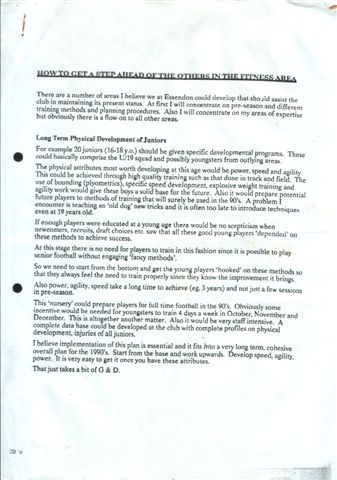
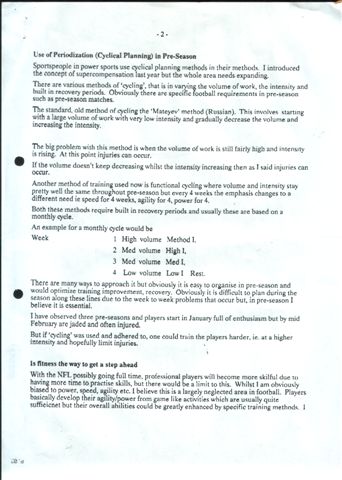
Secrets of Loris Bertolacci
This is from 1988 and I wrote it at Essendon Football Club so all history now.
Also I am not sure if anyone read it. I would write these things then shelve them. I must admit I was always very impressed with Brian Donohue who was Sheedy’s right hand man. He always listened intently to what I had to say and really embraced concepts like 3 weeks hard and one easy. Also he was computer literate and kept strict statisitics well before John Orchard did anything. And they were very well organized. He was ahead of his time.
These sheets are a bit like the dead sea scrolls, really but I hope of some historical interest given the development at the time of the 1990 team and the 1993 flag and the implementation of these concepts in those days long gone now that Hird and Sheedy are ready to go.
Hard to read but if of interest have a look. In a way all stuff volleyballers should do in theri development anyway.
I was giving Mateyev a bad wrap in 1988. And functional cycling then was hot off the press from Bondarchuk. Track and Field training techniques were miles ahead in the 70’s and 80’s. In fact all that has changed now with sports science and the information revolution is that lots of fine tuning needs have been studied that help the specific needs of individuals and situations like heat stress and osteitis management for example. These developments are fantastic but the basics remain.
And long term physical development of juniors. HA. Big business now!


George Bertolacci
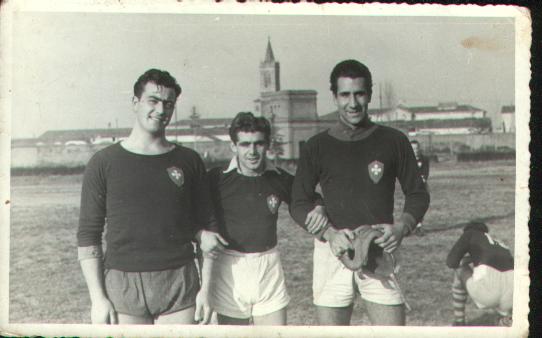
My dad loved sport. Talk about functional strength. He used to grab 100kgs at 45 and stand there and military press it for rep after rep. Then he could press me overhead. At his heaviest he was 155kgs and at his fittest was 110kgs. Big.
When I trained in Italy , all his mates in Livorno ( near Pisa) used to tell me about how he was the best arm wrestler going around and how they used to bet on Giorgio in the bars. He had massive wrists and even at my strongest he killed me.
Dad played Rugby Union in Italy with Livorno and was the kicker. He also played representative water polo and was a very good swimmer. He represented Tuscany in Athletics also and did a stint in graeco roman wrestling. All at state level.

He had a game or two of Aussie Rules in 1952, I think with Reservoir and kicked a few with place kicks. He came out to OZ in 1951 ! Apparently he replaced a player who went to Essendon so the story goes. He only had been in Australia for a year but had worked with the Americans in the war and so spoke English. He even had a training run in February with Fitzroy the next year, after a game with Reservoir and rode his bike to the wharf for work then back to the Brunswick Oval for training and promptly did his hamstring badly on the first night of training. So he started athletics again and competed with Coburg. He represented the state in the throws after that and was the anchor man for the wharfies at Port Melbourne and this shot was in the Herald Sun of those days.

He played Table Tennis a lot at a high standard and at 130kgs used to play against 50kg Asian guys at Albert Park. He had a short temper so sometimes the bat went flying and his opponent was in fear of his life.
He did a lot of soccer coaching in the 60’s until he started coaching me in Athletics. He started me in shot put in 1967 and I boomed. But like so many young people by 16 I knew it all and went on a long distance running binge to lose weight and as he had told me would happen, my throwing career faltered.
The last athlete he coached was Saverio Rocca in the discus and the big Sav had to come to my dads house and tell him that he was playing with Collingwood. I could see Saverio was nervous and dad was not happy. After all Sav was a better athlete than he was a footballer and I think dad knew he had lost a huge talent. Before that he coached many athletes and the best was Paul Nandapi. Paul won a heap of titles and medals in the commonwealth games. But with dad at 16 he was throwing mid 50’s with a senior discus and almost 17 metres in the shot put. Then he went to the AIS at 18 . Dad had a real knack of getting young athletes up and he won so many championships over 20 years. He never overtrained them and always made it fun. They sprinted and jumped and did a bit of everything and not too much of anything. It worked. The AIS sent him a plaque years later for his contribution the sport
He started the second pizza shop in Melbourne ( GIPIS) after TOTOS and one day 2 drunk guys came in and started a fight. I ran in and they knocked me out. I was 16. He grabbed them both and threw them in the car and when I came to, made me hold them and we drove to the police. One was the middleweight boxing champion of Australia. One chap once grabbed a pizza and ran out, and dad at 45 sprinted out the shop and ran down High Street and rugby tackled him to the ground. Big fast twitch man. The thief coudn’t believe it. Lots of Fitzroy players lived in the Northern Suburbs and they came to GIPIS after a game. Dad was a great sketch artist and would make funny sketches of players like Gary Wilson.
We always had sportspeople around our house. Kevin Murray ( Fitzroy Captain) lived up the road in Reservoir and was a real friend of the family. Whenever Italian sportspeople would come out to OZ Dad would seek them out and invite them home and Mum ( Rosa ) would cook them a treat. Fencers, athletes, boxers. All world class sportspeople at our house. I remember once dad picked up this boxer who was going to fight Johnny Famechon as he marched to a World Title. The boxer was from Livorno ( dads town) and in the car he told us he was retired ( Ex – European Champ) and was out only to earn some money and help Famechon get up the rankings!
I think a special day was Sundays at the Bertolacci house. We would train at the Preston Athletics Track at Edwardes Lake. Often some good throwers would appear to train with us like Matt Barber and Phil Nettle and other behemoths. They would come home to Lunch with Paul Nandapi and a few other big guys and mum ( Rosa) would have about 100kgs of pasta ready and 189 Schnitzels and bowls of potatoes and so on. They ate and ate. I watched in amazement. Then they went in the lounge room and watched World of Sport and fell asleep. When carbed up they would the weights on Sunday night.

Once Saverio went to Collingwood , dad decided to wrap it up and I wish he had kept coaching. Kept him switched on and a step ahead of diabetes. After that he moved to Rosebud and lost touch with coaching and fell into ill health. Rudy Villani my cousin ( and a great athlete) said at dads funeral that George had given us our love of sport and an appreciation of all sports. He loved to watch great athletes and loved all sports ( loved AFL) and this was very important for our overall sports development.
Thank god he died before all the crap was written about me in the media in 2006. Mum and Dad would never have understood it and to be honest nor have I. Had nothing to do with sport dad. But one thing that dad left me was a love of sport, and that remains and I will coach and produce athletes and high level performance just like he did .
Sandilands, Osteitis Pubis and Rotations in the AFL
It was reported in the media that Aaron Sandilands from Fremantle has Osteitis Pubis. In 2005 especially I noticed early in the season that clubs like Sydney, West Coast and Adelaide were playing 2 Ruckmen. There had been the intervention with the centre circle to stop PCL injuries. But clubs had realized that playing 100 minutes plus for ruckmen was just too much. Almost a midfielders role and yet these guys are huge men. Some have amazing endurance capacities but still big blokes who are not going to excel in distance running. They are more like big rowers.
One exception was Jim Stynes who played so much football. He was quite light and an exceptional runner and also played in another era.
The problem that clubs had and have is that their ruckmen has to get some possessions and be a normal player unlike the lumbering giants of the past. This was the only way of justifying 2 ruck players.
Coaches in general were scared to go 2 ruckmen in the early 2000’s ( although EFC had Alessio and Barnes) given they wanted run. So rotations and ruckman that can get their hands on the ball have become the key. And so many ruckmen were worked into the ground in this period when the game became super quick, making them look even worse given they often played 100% of game time .
I was very keen for this to happen in 2005 . IE Rotating ruck men and rotations in general. Sydney had Ball and Jolly,West Coast ( Cox and Seaby) and Adelaide ( Biglands and Hudson). All these players rotated almost predictively when interchanges were studied and also had an impact on the game both as ruckman and as general players picking up kicks and stats around the ground. Also given the increase in the speed of the game the theory was to decrease their risk of overuse injury and injury in general. But performance was the main aim.
So back to Sandilands. I don’t have his game time statistics but it seemed to me that in 2006 he played a lot of football on the ball and did some very hard running. He played 18 games and bore the brunt of the load in the ruck as far as I could see.
Just a tough gig to do it without adequate help. Ottens and Blake are working effectively in tandem now since Mark has matured. In the Sydney final of 2005 King was playing his 3rd game in 18 days ( Sun RD 22 Rich/Sat Final Melb/Fri Semi Sydney) and came up against Ball and Jolly by himself and was off with a hamstring by the 3rd quarter. Ball was the class act and Jolly is a good hard runner.
So Osteitis is often a reflection of load and the inability of the core to stand up to fatigue. I think we will see Sandilands rotated a lot more next year.
But eh I might be wrong. Trends and players often go against theories. What will be the new trend in this area? 2 * Jimmy Stynes?
AFL , Patrick White , Drugs and Tour De France .
I was listening to a debate on drugs in sport ( Tour De France mainly) on SEN today with Patrick White and it was frustrating. The whole area is so sad. My main concern really is the recreational use of steroids in local gymnasiums in Australia. People make money out of naive men who want a quick fix with muscles and don’t know what they are doing. Huge health risks await them later in life. That needs to be addressed with a massive educational program with kids.
I find the debate on drugs in sport so difficult. AFL players in a sense are not elite athletes. They are awesome all round athletes, but they are measured by wins and losses and statistics and coach appraisals. Not by having to squat 230lgs, for example, to improve their performance. What I mean is that usually AFL players do not directly link training statistics with performance. AFL players in general don’t come to you and say I want to run 9 mins for a 3km or squat 200kgs. ( Some do of course!). And this is because the link between improvement in training variables and performance is not as clear as many elite sports.
Elite athletes directly know that if they can increase a few measurable variables in their training they will improve. Also with AFL there are so many areas to improve and one plays a juggling act with it. Get too big and strong and endurance suffers, but run too much mileage and speed suffers and so on. So most players are good at everything without being special at anything. And the ability to repeat speed is at a premium and this is not a specific trait.
The debate about whether anabolic agents could assist recovery and rehabilitation is that, a debate. But the season is long and again nutrition and recovery methods win out in the long run.
There is no doubt that steroids were sneaking into the AFL in the 70’s and the 80’s. Too long ago and who cares but it was on the increase and thats that. So ASADA and the AFL has done a good job.
But from a philosophical perspective I always cringe when players get jabbed before a game with a “legal” painkiller. A drug is a drug. So once caffeine was made legal then it was ok to pump those NO DOZ in like lollies. But in the “old days” if caught with 6 short blacks you were tainted a criminal. I got dragged into the media because Darren Bewick took 2 NO DOZ before a game in 1998 when he had the flu and became sicker and I didn’t even give them to him. It was huge, and luckily the Alistair Lynch “scandal” was on at the same time.
This is the same situation that occurs in Society. Alcohol is legal and if you don’t drink and drive you can get totally drunk and thats ok. Weird.
My main worry with steroids is health. I support drug testing because I wanted to compete drug free but one is naive if people think sport in Australia is drug free and that one sport is cleaner than the other. After all there are so many ways people get around the system that really who knows half the time what is going on.
The media goes in hard when there is a sniff of drug cheats.One see pictures of people caught on drugs and they look like mug shots. I would go in harder when club officials are caught drink driving. But I am a cynic and that doesn’t sell papers.
Below is a transcript of a radio interview with Warwick Hadfield that I did a few years ago and the link to ABC.
http://www.abc.net.au/rn/talks/8.30/sportsf/stories/s1138355.htm
Program Transcript ( June 2004).
Warwick Hadfield: The big issue this week is once again drugs in sport, but this time it’s in Australia.
Loris Bertolacci: From ’75 to ’82 both here and overseas, by a number of coaches and in a number of situations in capital cities in Australia, and round the world, I was encouraged to take drugs.
Warwick Hadfield: Were some of these coaches attached to the Australian Institute of Sport, or similar official positions at the time?
Loris Bertolacci: I think I will leave it at the fact that there were a number of coaches from ’75 to ’82 that I think as a general interest in that it came from me because they saw me as a potential talent to take drugs. I don’t want to say they were attached to any official – you can actually work that out for yourself.
Warwick Hadfield: That’s former hammer thrower and now leading Australian football fitness co-ordinator, Loris Bertolacci, a member of the first intake of athletes into the AIS back in 1981.
I put his allegations to the Australian Sports Commission. A spokesperson said that without the names of the coaches, those allegations had no credibility. The spokesperson added both the Commission and the AIS have and will investigate all credible allegations brought to them.
Bertolacci’s claims come to light as just 49 days before the Olympic Games, Australia finds itself embroiled in the biggest drugs scandal in its sporting history.
This week sprint cyclist Mark French received a life ban from the Australian Olympic Council, after being found guilty of possessing two banned drugs. He has appealed against that ban, saying he wants to clear his name.
The Federal government has also set up an inquiry into allegations five other cyclists were involved in using the banned drugs.
There is, however, no evidence on this occasion that AIS coaching staff are involved.
Back in the 1970s and 1980s Loris Bertolacci, now 50, made the decision to resist all the urgings and compete drug free.
Loris Bertolacci: There were two very firm reasons for me, that was the critical factor was one was health, I always was a strength power athlete and people that knew me that liked to go for a run didn’t really want to put on much weight and thought about the long-term. So it was health. There’s probably three reasons. The second one was I found it particularly boring that people with sometimes a lack of talent could improve so dramatically in the gym and on the track and that. And let me preface that by saying that there are some genetic talents that didn’t need drugs that did perform admirably, and that’s the unfortunate thing.
Warwick Hadfield: What do you mean by that’s unfortunate?
Loris Bertolacci: Well it’s unfortunate for those people because some people that are genetically talented, and we see them in footy obviously Wayne Carey and these people here, they actually are far better. There’s only probably ten great players or five great players in the AFL, and they’re talented, they’re genetically talented, they’ve got skills, so therefore they perform above the level of the others. The same in track and field, weightlifting, whatever, you do get the odd ‘freak’ or people with genetic endowments that does perform at a very, very high level, and then unfortunately they get tainted with drug use, and certainly I wasn’t a genetic talent, I was just a very, very strong guy, naturally. The other thing was that I had an intense desire, and people that know me would understand this, to train as hard as I possibly could for ten years and beat the guys on steroids, basically by just being stronger and harder than them, because I just didn’t like the scene, really.
Warwick Hadfield: Does it frustrate you though that many of those people who did take the steroids are now regarded as – well, their records still stand 20, 30 years down the track?
Loris Bertolacci: Well first of all it was my own fault for retiring at 26 for personal reasons. I could have actually thrown a lot further, so I’m not going to blame it totally on steroids. But I did back myself into a corner a little bit and whilst I could have improved, there were some people that wouldn’t have been as good as me, I’m convinced about that, that now probably rank higher than me in certain areas, and there’s certain people that didn’t take steroids that performed a lot better than me too. So I’m not naïve.
Warwick Hadfield: All these years down the track though, some of these people who you knew to take steroids are not in the same good health that you’re quite obviously in right now.
Loris Bertolacci: Yes, look, I’ve met a lot of people in the past from gyms in sport and everything like that. I found it’s had an impact on their health. That is a huge factor in this whole area, and it’s a bit like people that take X this year at 30, they’re finding they’ve got symptoms of Alzheimer’s, or people that drank themselves into oblivion through their 20s and are in health now. I’ve seen people that I work with in gyms, clients that were in gyms 15, 20 years ago, bouncers that really rue the fact that they did this now and have high blood pressure and problems with thyroids etc. etc., and even some further health problems. I think that’s a major impact later on in life when the thrill of the chase has gone.
Warwick Hadfield: So why, there’s been testing for years now, it’s very, very high profile, all the side effects are well known as well. Why do you think even now, all these years on, people like what’s happened at the AIS, the cycling, in the last few weeks; why do you think people are still taking these incredible risks with banned drugs?
Loris Bertolacci: A number of reasons. I think, I certainly thought about it, I can understand the psyche because you do want to get into the top 10, top 50, top 20 in the world, you do want to go to the Olympics, you do want to wear the national tracksuit, you do want to achieve something, it’s a lot different competing in a windswept velodrome in, well it used to be Brunswick didn’t it? against going overseas and to an international thing. So the lure of the international circuit. There is money, and certainly instead of actually having to work in a mundane job, a lot of these guys can sustain their life for ten years. And it’s just that intangible that people are after, they just become very desperate, and they close their minds to the risks. And it’s probably a folly of youth too, in some regards, and an irresponsibility of people that are attached to them, i.e. I’m saying coaches quite possibly here, who you’ve got to lack respect for them if they condone this, because we have a huge responsibility to our athletes here.
Warwick Hadfield: What about the sports though which have been clearly identified as where drugs are abused: cycling, it’s emerged, the power sports, weightlifting and hammer throwing and so on. Will a time come when parents might have to say Well if my child pursues that sport, they’re going to have to make this tough decision about drugs, and parents may need to take responsibility for pulling their children out of those sports.
Loris Bertolacci: Certainly you have to worry if you’ve got a child that’s veering towards those sports and has an intense, fanatical desire to improve. You do have to worry about their future involvement.
Warwick Hadfield: The story from the AIS in South Australia is of a shooting-up room. Is that something that you’ve seen in your experience in sport in the past? A room where people go to inject themselves rather than have it done by doctors with illegal drugs?
Loris Bertolacci: I think unfortunately yes, certainly here and overseas, time and time again before national titles or in different places etc. and even overseas, and with professional assistance without, and unfortunately now just as we see people can go on the internet I suppose and work out how to construct a bomb, I think that the flow of information in society now, from every aspect is massive, and the ability to get what you want is very easy. So I think it’s a bit naïve of people to think I would assume that things have actually tightened up.
Warwick Hadfield: Former hammer thrower, Loris Bertolacci.
This is The Sports Factor on Radio National. I’m Warwick Hadfield, and this week, the scandal that could destroy Australia’s reputation as a world leader in the fight against drugs in sport.
The two banned drugs found by cleaners in Mark French’s room at the AIS cycling annex in Adelaide were testicomp, also known as glucocorticosteroid, and Equigen.
Testicomp is an anti-inflammatory and only attracts a minor penalty if used by sports people.
Equigen, a growth hormone for horses is, like all growth hormones, banned by the International Cycling Union and the World Anti-doping Agency.
Dr Sue White is a member of the Australian Sports Medicine Drug Advisory Council. She explains why a product meant for horses might have suddenly become attractive to athletes.
Sue White: The actual fact that it is an equine growth hormone means that it doesn’t have the same restrictions as human growth hormones to access. To get human growth hormone in Australia and certainly overseas, there’s lots of restrictions on it placed through the government, placed through the prescribing organisations. Those conditions don’t exist in the veterinary world, because this drug is not a banned drug from their perspective, and so you would be able to access it through fairly standard means and I also believe that it is not particularly expensive.
Warwick Hadfield: So what else do we know about Equigen?
Sue White: Well the things that we do know are basically that it’s a veterinary drug used in horses and it’s specifically a horse growth hormone, and we certainly haven’t been aware in the past of anyone trying to use it on humans.
Warwick Hadfield: What would it do, what are the things that it does for horses that might benefit humans who are competing?
Sue White: Certainly the things that it would do for horses, they would get improved muscle mass, potentially decreased body fat, there’s certainly been no specific discussion on whether it is ergogenic, which means it actually increases the power output or the aerobic capacity, but certainly the body composition seems to be the primary effect. But the interesting thing in this case is that we know that growth hormone is quite species specific, so we know that certainly growth hormone in pigs is specific for pigs and it is more than likely that growth hormone for horses is specific for horses. So in fact these athletes may have been using this medication without any effect at all, except possibly negative effects.
Warwick Hadfield: One of the reasons we don’t know that is that there are ethical reasons for not actually testing this drug on humans, so the athletes are able to test it on themselves, but the testers, the people who are trying to catch the athletes out, haven’t in the past been able to go out and see just what it might do.
Sue White: There’s lots of problems with researching drugs in sport. One of them is some of the ethics, even with the drugs that are prescribed for humans, using those on people that don’t have the actual medical indications for that drug, it becomes even more of an ethical issue if you would like to try and test humans with products that are designed for animals, and I can’t imagine any Ethics Committee agreeing to allow that to happen because of the potential side effects.
Warwick Hadfield: Are there at this stage any known side effects of humans using this drug?
Sue White: Well because we don’t know of humans using it in the past, no, we don’t know. There’s certainly been debates about the use of animal products or drugs for animals in humans in the past, and some of the thoughts have been things like the production of abnormal antibodies, possibly if it does have an effect in humans, then it could have similar side effects to human growth hormone, which is a condition called gigantism, where you get increased bony structure in the face, increased hand size and certainly problems with some of the internal organs.
Warwick Hadfield: One of the reasons that athletes tend to use the growth hormone that’s made for humans is that it aids recovery. Does this horse hormone do the same thing?
Sue White: Well we still don’t know if it does that in humans. In horses, it’s mainly prescribed for ageing horses, so certainly improving recovery would be one of those things, but there’s no indication at this stage that it would be doing that in humans.
Warwick Hadfield: What are the broader issues here in terms of Australian sport? We’ve valued ourselves as being pretty clean in this area. Is this going to do damage to Australia’s international reputation in the fight against drugs?
Sue White: I think any time any of our athletes are involved or appear to be involved in an issue such as this, I do think it damages our reputation, and as we’ve always said, it’s unfortunate that we hope that it’s a small group of athletes, but it does tend to reflect upon all of our athletes.
Warwick Hadfield: Is it sports-specific? Are there some sports where drugs are more notoriously used than others?
Sue White: There’s no doubt that there are certain sports that have more benefit from using drugs, and they tend to be power and strength sports, and endurance sports. So many of the track events, many of the field events, swimming, cycling, but things such as synchronised swimming or diving that are perhaps more subjective in their judging, not just a pure number at the end, but possibly involve some more specific skills, are less likely to benefit from drug taking.
Warwick Hadfield: THG, human grown hormone, was supposed to be the drugs for Athens. Now that it’s been discovered it’s being used could you see this test being formulated for this and this one popping up a bit more in Athens?
Sue White: I’m not really sure with that, and one of the reasons is that I remain concerned about its efficacy in humans. The fact that this drug can be quite species-specific, I wonder whether athletes that are choosing to use drugs may choose to use the ones that have been tried and tested in the past, and work.
Warwick Hadfield: So we might just have some pretty silly people dabbling with things about which they know very, very little?
Sue White: It is distinctly possible.
Warwick Hadfield: And potentially endangering their own lives?
Sue White: Absolutely.
Warwick Hadfield: Dr Sue White.
WADA, the World Anti-Doping Agency, is promising a test for all growth hormones, human or otherwise, for the Athens Olympics. But it may not be that effective. Growth hormones, apparently, work their way out of a person’s system after just a couple of days.
Loris Bertolacci sacked
I can have empathy with the coaches that have been sacked recently. Many years ago I worked as a barman at Crystals T striptease joint in Brunswick. It catered more for hens nights so all I usually saw was blokes taking their clothes off . Wow! A friend got me the job and I needed the money since I was working in the AFL at the time. I drink very little alcohol and had zero idea of how to mix drinks. I had to learn very quickly because “crazed” women out on hens nights can put a lot away. Well I failed. I wasnt motivated and didn’t really want to look at blokes with “tied up penises” gyrating onstage. I couldn’t keep up with the complexity of the drinks and after 2 weeks I was sacked. I considered legal action but really they were correct in sacking me. I was no good at my job. So I moved on.
Next job was cleaning at a safeway at nights. It was a 3 hour gig but I made it into a fitness session and ran all night , sweeping in quick bursts, buffing at high intensity and mopping with gusto. All muscle groups were worked and the buffing was great proprioception. I changed direction a lot and ran up the stairs for the sake of it. The people stacking shelves thought i was on uppers.
Home two hours early and in bed and still I had done a great job. What a cleanathlete. If they had a cleanathlon I would be world champion. The supermarket was spic and span. Every month the supervisor would arrive at 12 and I wasnt there and he nearly sacked me a number of times. I would do the right thing for a few weeks and stay for 3 hours and then go back to high intensity cleaning again until he caught me again home fast asleep!
He had a problem. Like a junior coach who has to play his star player even though he doesn’t train, I was just too good to get rid of.
Thus I developed a periodization plan where I had one month of high intensity buffling/mopping done in an hour to low intensity recovery cleaning sessions of 3 hours.
And really this is a model that should be adapted universally to allow people the opportunity to vary their work and fitness.
Great job and left with good references and superfit.
 loris bertolacci