New Richmond Coach? AFL Coaches. Young? Old? Average Age?
How silly is the debate about AFL coaches and age right now.
AFL is such an insular sport and simply there are only 16 jobs available right now. Even in Gridiron there are more jobs and then good jobs at Universities in the US. Soccer and Rugby Union are worldwide so there is a huge pool. And in all sports simply the best coach gets the job with individual athletes and/or teams.
I saw the development of full time AFL. And in 2006/2007 I assisted the Western Bulldogs with a consultancy on their ACL injury plight and speed and power programs. I pointed them in the direction of where the game was going, repeat speed and repeat power and specificity. I provided an insight into how far behind the club had been in overall development from physical preparation to staff needs and so on. Not so much that their coaching or fitness had been poor, but how poorly resourced they had been given they had done an amazing job with little.
All of the current crop of young AFL coaches played AFL footy full time. They experienced this 9 to 5 job. I had been involved in track and field here and overseas so was privy to sports science and full time training. But when I went to Essendon in 1988 I got the shock of my life when players were turning up in overalls at 5.30. This continued till 1993 when Essendon dabbled in F/T footy. And even in the UK soccer had fallen behind Europe in the 90’s given the ‘OLD” coaches were clinging to the old days. But hey Hiddink is old and he knows what is needed in elite sport? Confused! Think about the wealth of jobs and the width and breadth of the soccer industry and so one is simply a coach.
But till 2000 many of the “old” coaches still wanted to train at 4.30 and Mark Thompson used Denis Pagan’s timetable in 2000 despite the reality we should train full time and that AFL was a 9 to 5 job now. But Kangas won a flag so 4.30 must be the right time eh?
So many of the “old” coaches from the VFL had to be dragged kicking and shouting into modern AFL or more correctly, Elite Sport.
I organized an expedition to the AIS in 1997 at Essendon and it took a lot of push to get people to go and Peter Jackson really had to make it happen. We listened to all the AIS people for a week and then went back and re-organized the processes at Essendon. Essendon led the charge then.
The one constant in life is change! So it is not about being 37 or 48 or 58 but whether one realizes that things always change and evolve. My opinion was that many formt he old VFL struggled to grab the concept that AFL was full time and elite and not like the good old days. But soon the old VFL people will simply be a thing of the past.
So what has happened is that some coaches have evolved well with full time AFL maybe such as Malthouse given they have grown with it. I am not privy to Collingwood, so have zero idea of how far he has evolved, or does he now and then hanker for the good old days? Others I think, tried to hang on to the old way of coaching and didn’t embrace the business nature of day to day operations. In the now famous Brian Cook review even Mark Thompson was viewed as having too much on his plate. I was gone in April 2006 so only read the review. HA!
But in time many 37 year olds will be 49 in the AFL and will have amazing sports science experience and elite coaching expertise. So in 2019 do we simply recruit 35 year old coaches because it is AFL and that is what you do. Duuuhhhh…In then end Voss has walked into a fully organized mega structure and also many of the players of the ‘ADCOCK” & RISCHITELLI age have had quite a few pre seasons. So maybe he has walked in when a core of players have started to mature mixed in with some good old players. If he had gotten the job 3 years ago with heaps of 1st year players how would he be viewed now? Clarkson just snuck in with finals. Just in time! Thompson was in finals in 2000 and then a Prelim and Semi in 04/05. Despite the media about it taking 8 years to win a flag, this was a quick turnaround. If GFC had finished 13th and 14th in 04/05 I doubt he would be there or I would have been headhunted for jobs in 2004 and 2005!
I think this is a very simplistic and poorly researched argument that is being put forward about youth and the AFL and coaching. ALF is only a National Sport. Why are these journo so closed in their thinking and only use the AFL as a rationale for their articles. AFL is an elite sport in OZ, not the world. There are 800 odd players. Not too many are elite! If it was so easy heaps of UK teams would employ young UK coaches. They tried a few times and agghhh!
I always looked outside the AFL for changes required. IE In elite sport. Soccer/Rugby/Hockey and so on. Obviously we have taken “years” to copy soccer with tactics. Geez Zoning! New? That is why I often went to the AIS and world soccer to look at what they were doing! In the end we don’t produce heaps of athletes as it is and our first gold medal since 1968 was won by Hooker.
So in this argument about who to employ as coaches simply look at sport in the world and then the needs of AFL . AFL is not a unique sport. It is sport with unique needs. It isn’t rocket science.
And examine the evolution of the AFL and also why young coaches came flooding through. They were simply working full time in the AFL since the late 90’s and basically players who were just retired were employed. Old 60’s and 70’s players rarely got assistant jobs. But now heaps of 45 year olds can be sophisticated IT gurus!
Sad that some “GUN” 45 year old coach may not get a job. Someone has to win a flag every year so if they are all “young” then a young coach will win. In the end the AFL is a manipulated sport where squads spit players out and lots of underprepared kids play, given the system in place with “kiddie” programs.
Average age of AFL players in Grand Finals is 25.6
Average age of elite coaches in the world?????? Who knows? Who cares!!!!
If I can get a 21 year old to coach me to win the Veterans 50-55 100m title I will listen as I will listen to an 80 year old.
I always have to remember that the AFL media, in general, does not go past the obvious.
Ciao
Long Term Athletic Development LTAD at Collingwood
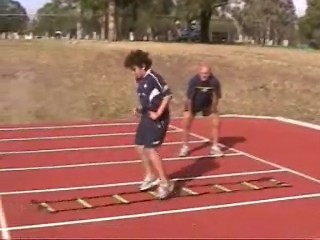
Here I am at Collingwood Athletics Track supervising Brunswick Zebra’s 11 year old goalkeeper ( Yanni Matzaris) doing his footwork on Sunday morning 22 March 2009.
But is this LTAD gone mad. 4 year old Joshua Mercuri is ready to fly at the end of this explosive but zig zag parachute run! Too young. Ha. He loved it and tried as hard as he could to get airborne. Josh’s dad Tony owns the 24 hour gym ( Five Star) in Thomastown.
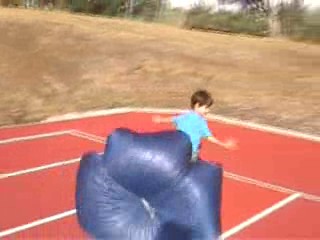
And here is his 7 year old brother Adam. So fast the picture is blurred. HA. But he also loved it. The secind picture also demonstrates some multidirectional training, or maybe just being blown off course!


Marija Mirkovic, Yanni and Con Matzaris are doign a few strides down the track. Marija won the National Junior Tennis singles and doubles championships in 2008 and I assist her with fitness. Marija is off to Europe for 6 months on Monday and today did a short speed session before heading off. She is rapidly improving her ranking and will use Belgrade as a base for the ocming months. She is a very hard trainer and super fit aerobcally and I am sure that with more tennis and more power work she will kepp improving.
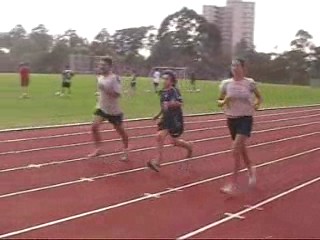
Adam come back!

Yanni Matzaris and dad Con after a good session.

Marija slamming a medicine ball into the wall working those obliques.
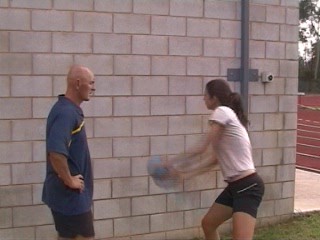
And Marija doing some “off the mark” training.

This is “moi” and Marija. How to ruin a good shot eh!
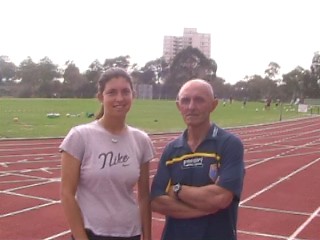
And back to Joshua tryig to fly again!

And Adam working those glutes with parachute straining behind.
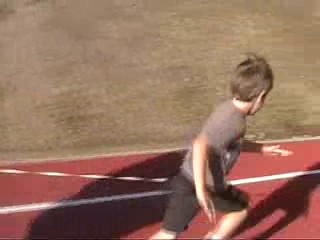
Look dad!!!!!

Guees what FUN!
Ciao
AFL FOOTBALL, HAMSTRING INJURY and GPS
Hamstring Injury is on the rise again it seems in the AFL. Yet we are seeing the AFL gloat about how the rules have changed the game and made it less dangerous for contact injury and link this to the rule changes. An article by Damian Barret quoted the decrease in high intensity running in the GPS report.
“THE AFL’S GPS data from the 2008 season has revealed a fourth consecutive increase in “playing intensity”.
Among results that delight AFL football operations manager Adrian Anderson, who has introduced a raft of rule changes, the 2008 season saw players spend less time at “high-end speeds” and more time at “steady-state running speeds”.
The report quoted Adrian Anderson noting the decrease in collision injuries since 2004 but of course we also have had far more stringet tribunal decsions with head high contact cases for example. So one has to be a little wary of making rash conclusions with this GPS research. Also the report said that ball in play had increased over 10% since the 2001/2002 season but of course one must remember that extensive GPS use was not occuring then.
“Anderson said there were strong warnings at the end of 2004 that the game had moved too far to a stop-start style and, as a result, players were suffering serious collision injuries because when the ball was in play, they found themselves playing at a higher speed”
So why have Hamstring and Groin injuries increased?
The attention to detail in the area of soft tissue management is pristine these days in the AFL. What this report totally misses and what GPS really struggles with is that there is a maximal instantaneous muscular effort occuring time and time agan in a game. So whilst players are fatigued due to less rest thay are still contracting at maximal effort close to the ball increasing the risk of soft tissue injury. GPS does have accelerometers that measure impact forces but again this is not measuring the maximal contraction of a fatigued muscle.
And added to this problem is the massive interchange numbers which means a fresh player comes on a totally fatigued player and adds to the need to maximally accelerate at an instantaneous moment. WHACK more injury. Fatigue causes loss of efficiency in movement apart from other problems that expose soft tissue to injury.
So whilst a player may be cruising at a slightly lower speed they still have to bend and crank 100% effort many times over and in a more fatigued state. Just not something a GPS can measure. That is, the massive instantaneous eccentric contractions that occur at maximal intensity compounded by the fight or flight response.
So again we see the flawed use of statistics and technology. GPS was fantastic to allow sports scientists a clearer picture of game loads and variations from training to games for example. Coupled with HR data and subjective data and linked to video one can really analyze general game loads for AFL players.
Reality all that may have happened is that the rule changes have changed work/rest ratios and meant that coaches have to select slightly more “aerobically” biased teams with a result that players are running around slightly more fatgued than in the past. So yes it may nicer to watch but one can see where soft tissue is strainign even more now. And also one would have to look at the rule changes with collision injuries to judge whether that has been the main reason for less contact injuries.
It is the old story. One can use statistics to justify most scenarios. And also as in the grand final one will see a lot more euse of tactics that will again change many variables.
Little Athletics is not a good pathway for Track and Field excellence
Recently there has been a lot of discussion about problems in Track and Field. From sponsorship to simply numbers competing. There also have been suggestions that Athletics Australia does not provide a pathway for kids that do Little Athletics. So much has changed since the 60’s prior to when Little Athletic started.
We don’t have University systems such as collegiate track and field in the US. We don’t have systems with the armed services and police force such as exist in many countries. We do not have clubs aligned to big sports clubs such as in Europe. Senior clubs in Australia are a throwback to the 50’s. Funded and run by total well meaning amateurs.
So why do I think Little Athletics is flawed as a pathway for Senor Track and Field. Before I start I want to emohasise that from a physical point of view it is great that kids are running around on weekends with little athletics. But that is not the point of this article. How come thousands of kids and parents are involved in Little Athletics and these parents and kids drop out later? Is it simply Athletic Australia’s fault. No.
From a mulitalteral development perspective Athletics is not the best pursuit for kids to do prior to puberty. It involves closed skills, unilateral loadings and winning and losing at an individual level. There is no decision making and no team interplay. Much research has shown that multilateral development is the key for prepubertal kids and also games are best pursued to develop decision making skills, aerobic fitness and speed and have fun. Sports such as swinning and gymnastics are great for strength. And so on. This stuff is all out there.
Also up till 15 or 16 there are massive differences in development and maturation so who wins one year may simply be an average senior athlete. Average age for senior athletics for excellence is always approximately 25. So if your child wins an under 11 title it may be 8/12 years before any real performances start happening. 2009 now so wait till 2016 to make a semifinal of the under 19’s in senir aths!!
Parents have a huge involvement at this age and often with great intentions ( health and fitness) but soemtimes for not so noble reasons. That is they become involved in the whole win/loss cycle.
My memories of the best talents coming through were young footballers or hockey players who turned up at the track and ran 11 5 secs for 100m with no formal training off a base of multilateral devleopment.
i will continue this discussion but simply starting Athletics too early is flawed. It is a simple sport that requires massive dedication and should be grabbing kids from other sports at 14,15,16,17 and so on.
Councils need to get behind senior clubs and now is the time to pay coaches at the many tracks to help these kids that want to do Athletics as a choice at 15 etc and not because their parents took themt o Little Aths at 10.
How ugly is it for a kid who won medals at 10/11 and 12 in athletics to be beaten at a school sports at 15 by a kid who only has played soccer. Now that kid is bound to give up and also of course any involvement of parents in athletics is over given the excitiement of seeing little johnny is over.
All food for thought eh!
Ciao
Australian Tennis. What is the problem?
I have had a reasonable insight into tennis since about 1990 given then I had an association with Michael Baroch who is a well known coach. I assisted quite a few of his juniors for a few years and in the past 2 years have again had some gigs with some junior players with their fitness programs. I also worked with Ann Quinn at Essendon Football Club and again this provided me with some insight into the sport.
Many reasons come flying around this time when we seem to have less and less ranked players. Yet at the Olympics we seem to do well in some sports. Without going into it too much they are usually sports that have really benefitted from the Institute set ups and sports science back up.
We do not seem to have had too much success in sports that require high level eccentric conditioning at the Games. That is a topic for another post but relevant to tennis.
The obvious hypothesis re tennis is that the rest of the world simply started playing tennis from the 60’s and 70’s. Yet John Alexander says we do not have courts in OZ, all I see close to home is courts and coaches. Cannot buy that argument. Too simplistic.
We also have a traditon from the good old days here, and that seems to still have an influence. I remember in AFL it took till the late 90’s for the coaches of the old VFL to embrace professionalism. Even then it was a struggle.
European nations seem to have simply evolved their tennis in line with elite sports principles rather than what the “old pros” did in the past. In Australia there a lots of kids hitting massive amounts of balls. In fact some give up footy and soccer and netball in pursuit of tennis dreams at early ages and thus are denied the mutlilateral base these kids need. Same problem is OZ exists with Little Aths which is a healthy pursuit but a waste of time as nursery for track and field.
It seems to me that coaches really make their money with kids yet when it gets to 15 to 20 the clubs do not have any resources to create pro environmnts in OZ. There is a massive gap after puberty for players that only the institutes can fill, but too few kids get there and are they the right kids?. Talent ID is really difficult in a sport where the averega age for men in the top 100 is over 25 and for women over 24. It takes time to produce players. Youth policies take time. The AFL is a bad example with the under 18 system because it is a closed National system and who gets picked plays. No one from Ecuador to beat.
Sports Science to me has not been embraced as much in OZ with tennis. That is a pity given the resources we have.
Simply some thought has to be put into creating a large base of kids after puberty and then supporting them till 16 to 20 in some system that allows them to improve. The superstar will come through but that is one player every 10 years.
Coaches must work hand in glove with sports science and fitness and not run amok with massive loads on young underdeveloped kids. Some of these kids are so scrawny.
Power and speed must be prioritized as must be technique and fine tuning, versus running around the TAN.
To say we dont have players is odd to me when so many coaches make a living coaching little kids. So what happns to these kids when the parents no longer can afford to pay for lessons at 13? And it may take a player till 20 to break into he top 250 and till 22 to brea into the top 100. That;s ok and normal in tennis.
So giving some juniors some wildcards will not solve a thing.
Interestng eh!
AUSTRALIA WIDE SPORTS CONSULTANCY
AVAILABLE NOW AUSTRALIA WIDE
PRE XMAS TRAINING PROGRAMS FOR AFL FOOTBALL, SOCCER, VOLLEYBALL OR ANY INTERMITTENT TEAM SPORTS.
-WE CAN EVALUATE YOUR PROGRAM AND DESIGN A SPECIFIC AND INDIVIDUALIZED TRAINING PROGRAM FOR THE IMPORTANT PXMAS PERIOD.
-REHABILITATION
-SPECIFIC CORE STABILITY AND CORE STRENGTH NEEDS
-BASE AEROBIC CONDITIONING AND SPORTS SPECIFIC CROSS TRAINING
-STRENGTH AND POWER NEEDS PERIODIZED
-PERIODIZED PROGRAM WORKING BACKWARDS FROM THE START OF THE SEASON IN 2009
-FITNESS TESTING SPECIFIC TO YOUR SPORT
-ALL DONE IN DIRECT CONSULTATION WITH THE COACH
INDIVIDUAL SPORTS SUCH AS TENNIS AND TRACK AND FIELD
All aspects of your conditioning needs can be assessed and programs that are totally individualized and sports specific can be designed and implemented.
* VIDEO ANALYSIS
* LONG AND SHORT TERM NEEDS MET
* SPECIFIC FINE TUNING NEEDS MET
Loris Bertolacci
Strength and Conditioning Consultant for the Australian Women’s Volleyball Program
I have worked in many sports and can come to you and/or arrange staff to meet yours or your teams every individual need. People like Jarrod Egan are available. Jarrod worked at Geelong Football Club till 2002 then the Kangaroos in the AFL then spent a year with Celtic Soccer in Scotland. He is back in Australia and is available in NSW and anywhere in OZ for any of your sports training needs.
20 years experience in the AFL
NSL and Premier League Soccer experience
Currently assisting elite tennis players from Australia and New Zealand
Successful consultancy with the Western Bulldogs in 2006/7 on their ACL injuries and Speed/Strength programs reflects my ability to also come into your organization and provide a long or short term consultancy.
INTERNATIONAL LINKS
We have international links in Germany, Ireland and Italy and can also provide consultancies in these countries in very specific areas. These are highly qualified people like Chris Dennis in Dublin who works in International rugby and recently assisted Ricky Nixon with his Irish training camps for the AFL.
HAMSTRING REHABILITATION BOOK
My hamstring rehab book has been very popular overseas and interstate so I welcome you to check it out and assess what we can do for you.
Development in the Australian Football League AFL
I recently listened to Kevin Bartlett and Peter Daicos on SEN talking about development in the AFL. Daicos spoke about the importance of development. It was interesting but still missed the real factors involved in long term development in any sport really. In the end the discussion focussed too much on one or two years.
The AFL is a sanitized and manipulated sport. And so one cannot buy teams it seems. We have seen teams try to mix and match in the past few years and develop on the run by recycling some players. This simply has not worked. Most teams that have won flags recently have stuck with a core of players and worked through almost 10 years of development. West Coast Eagles started a restructure in the late 90’s with their list. Sydney had been though a lengthy period with a mature group before crashing through. Port Adelaide the same with a very mature group. Many years of pre seasons and heartache. And more so waiting till the core group was an average of 25 to 26 years of age with really good proven veterans and quality young players mainly from 21 to 25. Thats it. Add to that what seems to be a need to have some money floating aound to service the team with needs such as medical, fitness, massage and other critical needs. Clubs such as North Melbourne have certainly not delivered given they simply have not had resources in my opinion and yet have been thereabouts. I always use a seemingly trivial area such as massage to point out the need for resources. I am sure the power clubs have massive budgets for massage whilst North would have very little. This is not a 1% but may be a .25%. All adds up by finals.
Time and time again we point at reviews or culture or other totally nebuluous and subejctive concepts. If the team has a core of hardened players that have an average of 6 pre seasons and some finals experience one has a chance. If they average 100 games of AFL footy the chance increases. If the club is well financed the chance increases. If there is some relative and current political stability then the chance increases. We have seen recent examples of clubs winning flags with supposedly poor cultures so I query that one.
We are talking about young men who represent these clubs, but with mature bodies. Every club has a leadership group now but someone has to finish last. If the club can get on a winning role then usually everyone is happy including media and supporters. Added to financial stability this helps . Then clubs make good decisions when in a positive frame of mind and the positive cycle continues. Teams that lose a lot usually meddle and overtrain inseason. More disasters. Young bodies. Old bodies. Stress. Crash and burn.
When teams are firing, bodies are mature, but still vibrant and fresh, less injuries occur. It simply is less stressful. And when less injuries occur there is less drain on the current list and so again less wear and tear occurs and the load is evenly distributed. So less injuries.
Without talking about the science of it all, there is no doubt that a positive frame of mind can assist the avoidance of injury and illness so the whole cycle becomes “virtuous” and one is on a roll.
It takes a glut of injuries or total political instability and some losses to upset this “happy” cycle. Does happen and recent events have demonstrated this. Or in the end your best players are too old and young players too young and there are no warriors in between. By 2005 this was Brisbane. And did Adelaide lose their opportunity to win in 2006 with an injury glut at the end of the season Maybe? But now they seem to have old players and young players. So do they make a decision to go into a long term development phase or do they keep trying to have a crack by mixing and matching given they are so weel resourced and well coached. Tough eh! And is the Bullodgs now reasonable well resourced and with a quality core gorup at the right age? When I did my consultancy on their ACL injuries in 2006 at the Bulldogs I can assure readers that their resources were light years behind those of Geelongs without elaborating. It was tough for the players I thought, after having worked at Essendon. Colingwood and Geelong.
So development means that over time players have pumped weights, run miles, made heaps of decisions on the ground, learnt their skills from coaches, grown up socially and been involved in a vibrant well resourced club. After all there have been some excellent cultures with clubs that are poorly resourced and they do not seem to win.
Remember it takes time and in the highly controlled AFL compettition, 9 times out of ten one simply has to get the best players together at a young age, train them properly for 6 to 8 years and make sure the business is ok. You won’t win with a bunch of 23 years olds or a bunch of 28 year olds and it seems you won’t win with a paupers budget. And this is the AFL not Premier League Soccer where the best can be bought so the AFL’s contolled environment allows for objective analysis.
And then those 25 year olds have to be good players with the odd star. And really the 22 games is the accurate reflection of development. The finals are a slight lottery. And yes other things have to be ok, But get long term development wrong and fight nature and forget it.
Simple. HA.
Loris Bertolacci
Preston Athletics Club and Sunday Morning Training
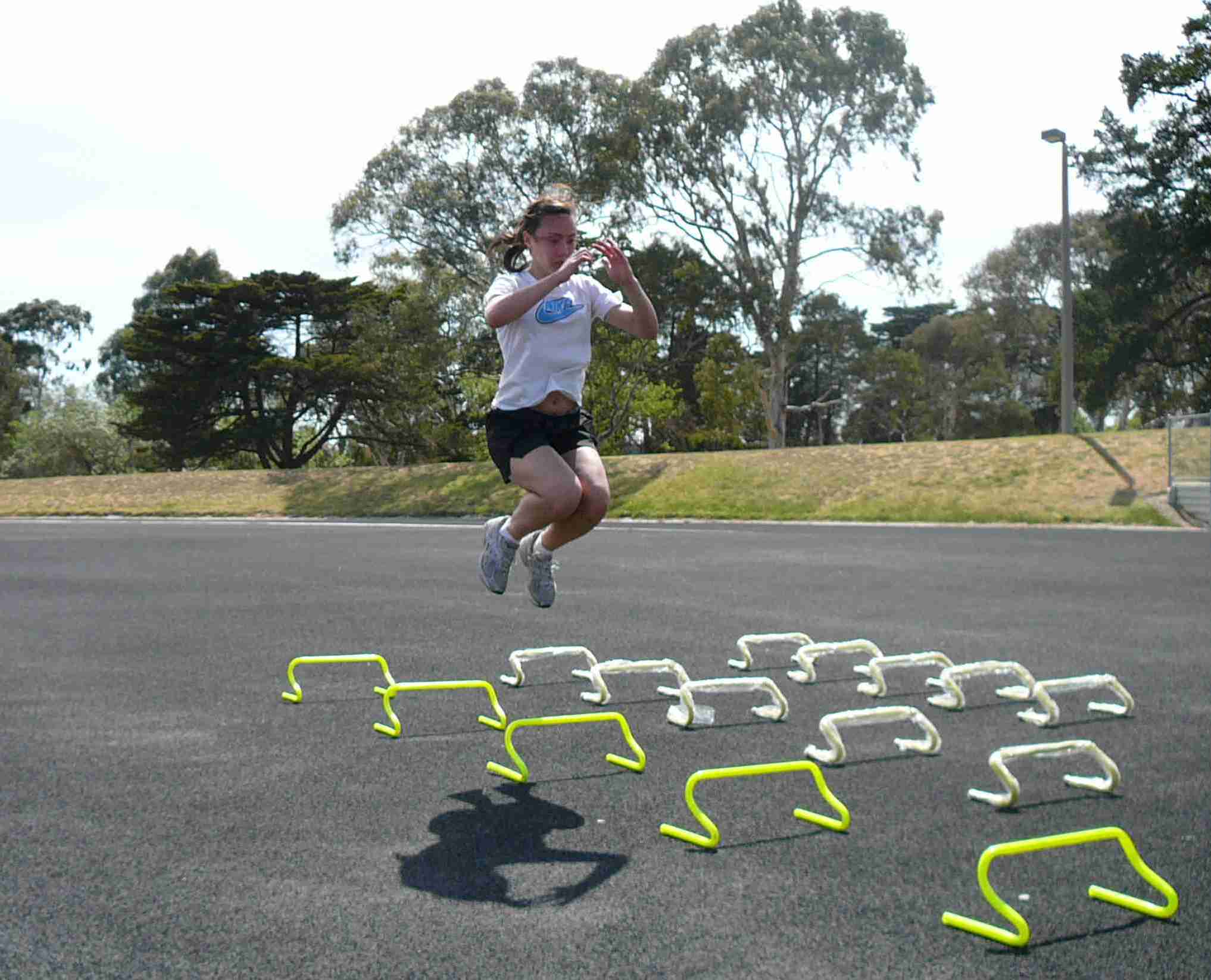
I was at my old club on Sunday 21 October and Jeff Hawkins was coaching his large squad. Melissa Drew, a sprinter, is seen jumping over hurdles at Edwardes Lake Athletics Track in Reservoir.
He successfully coaches all events and is an example of the talented coaches in sport who do so much for no financial return and actually provide elite coaching. In fact I have been involved with team sports at the professional level for 20 years and to be honest a coach like Jeff does it better than some I know on 1/2 million dollars or more. My brother in law ( Gus Puopolo) also provides a world class service to athletes at Ringwood and charges nothing and gets results. In all sports not just athletics. The contrast in coaching abilities with some ( not all!) of the people I have worked with is amazing when one compares the work ethic and ability of guys like these. But of course AFL and Rugby and all the other PRO sports get lots of exposure, so if a coach is involved with a winning team then instant guru status ensues. And that is the way it is. C’est la vie. Perception often becomes reality.
I started at Preston in 1967 and my dad coached me till the 70’s. I won the Nationals in 1980 training at Preston then went to the AIS in 1981.
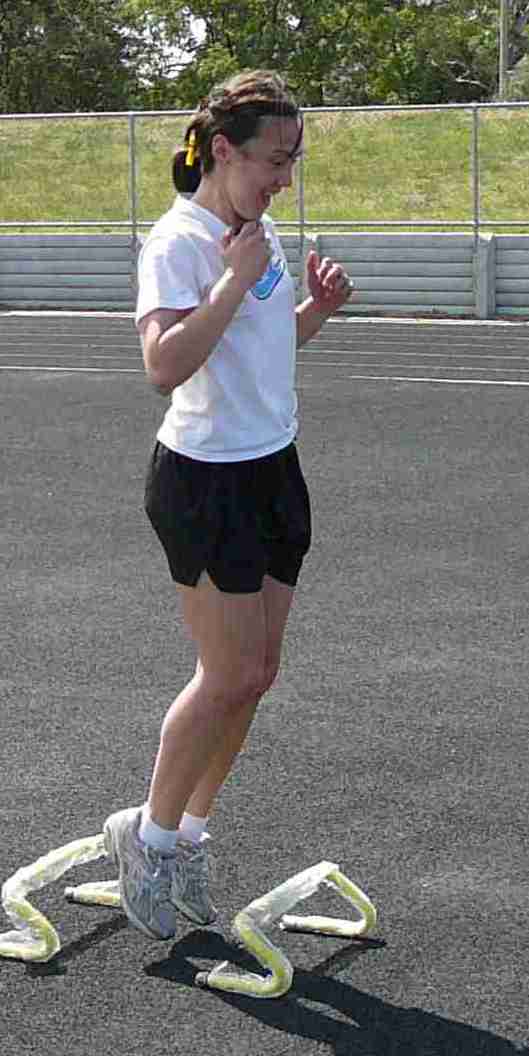
Jeff is seen coaching Melissa Drew ( white shirt) who has run 12.2 electronic and also Olivia Natoli ( blue shirt) who has just started athletics and has run 13.6.

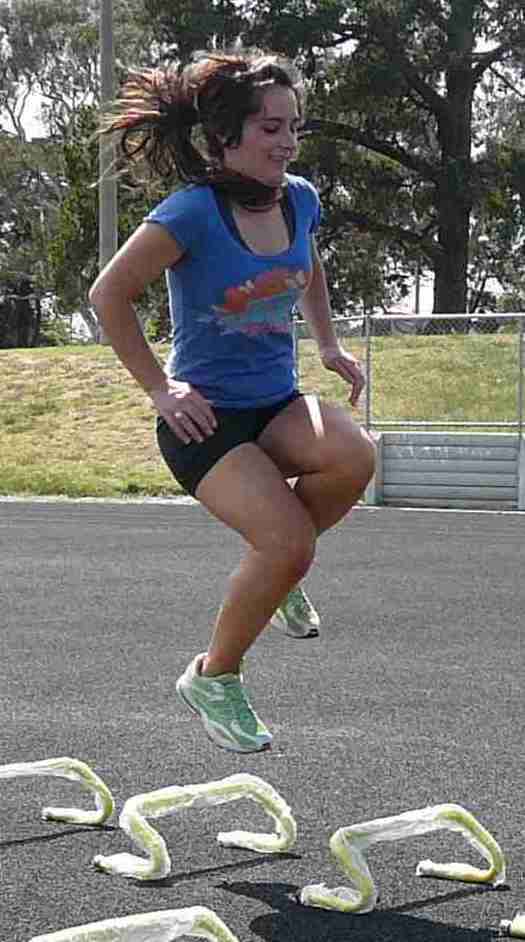
He can be seen giving advice to distance runners one minute and then conducting a plyometric session. Pretty impressive.
Melissa Drew seems to me to be a real hard working athlete who has ability.
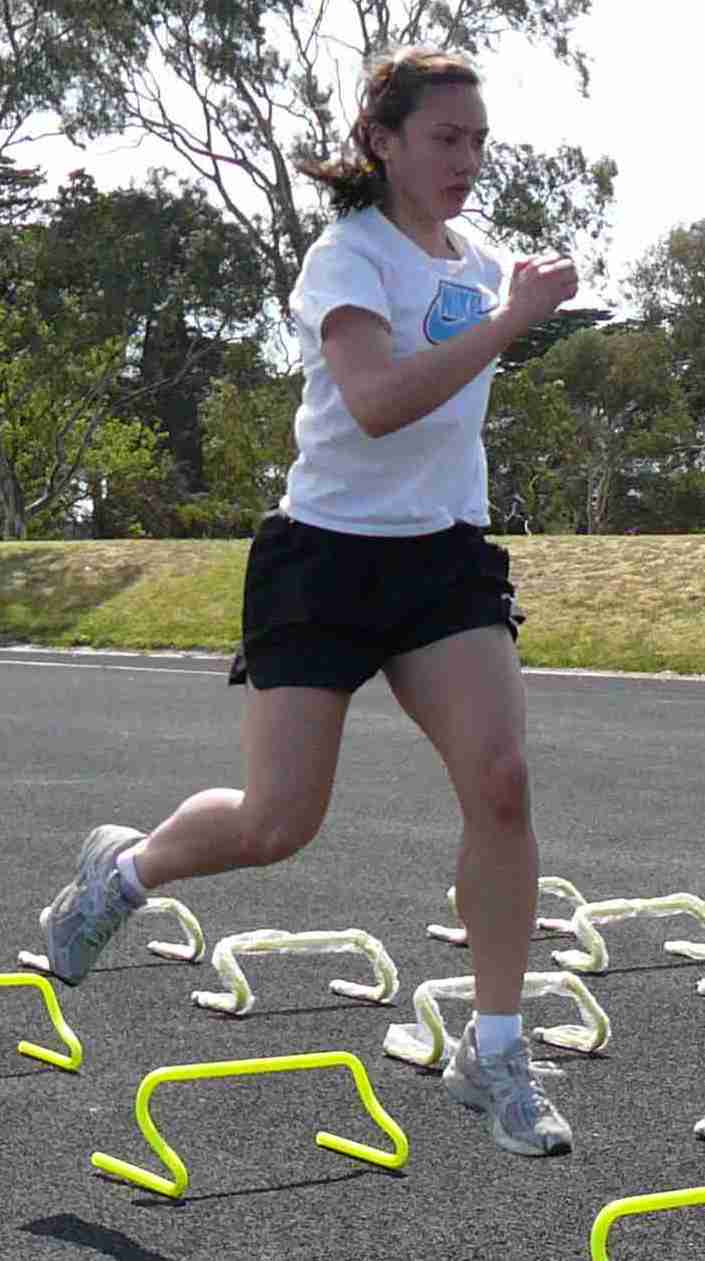
Good luck to Jeff, Melissa, Olivia and the rest of the squad for the season.
Hamstring Injury Statistics in the AFL and E Book
What qualifies me to write an E Book on Hamstring Rehabilitation?
I was a track coach in the 80’s before starting in the AFL in 1987 and trained some good sprinters and jumpers and so experienced first hand the needs of high speed running.
I was very lucky to work in the AFL for 20 years and to experience the day to day needs of rehabilitation, and in this case hamstrings.
Given this “hands on” practice I learn’t by trial and error. But also I was privy to many experts in this area. I researched every journal, went to conferences and spoke to anyone who seemed to know what they were doing, here and overseas.
From 1997 to 2005 in particular I was able to develop some specific strategies to try and prevent hamstring injuries and also rehabilitate them efficiently and not make mistakes in when to return to competition. Recurrences cause so many long term problems.
I have already gone through this in another article. ( Hamstring Injuries in the AFL. Perception becomes Reality). It involves a multifactorial approach. From core stability to running fast to recovery and load management.
The statistics I achieved validated my plans. I had an average of under 10 games lost per year to hamstrings. AFL has averaged approximately 20 games lost per club per year. My worst year in this block, was one year at average AFL statistics.
Apart from the AFL, I have worked with many elite sportspeople and athletes over this time and continue to do so. I have worked in soccer, tennis and track and field recently and saw the different demands on hamstrings compared to the AFL. This year I also did some work in Volleyball and the equation changes again.
The best way to learn how to do something is hands on. I have done that. But I also have taken an evidence based approach to ths area.
The E Book will have a comprehensive theory section and then some practical programs that can be used for 2/3/4/5 and 6 week programs.
I am sure it will be useful and interesting.
Health Club 101 in St Albans
Rebecca and Paul Galea own a great gym in Saint Albans Melbourne.
Excellent equipment, great prices and good people.
Make sure you join up. It is worth it.
Healthclub101
101-103 Main Road West
ST ALBANS VIC 3021
Phone: 03 9310 9155
 loris bertolacci