TAC system is flawed
Paul Roos has often spoken about the gap that exists between the U/18 AFL/TAC system and the actual AFL competition. It is often debated also that the old U/19 system was superior to the current U/18 system.
Paul Roos on Gap between U/18 & AFL
The other issue is education. The AFL has changed it’s age policy to make sure players complete their VCE. But there still is concern about players putting more emphasis on making the cut at the draft rather than working on their education. And in reality few make it through, but many put their heart and soul into the quest to get drafted. Anecdotally I have been told there is a literacy problem with young players.
Quote off Wikipedia: “From the 2009 draft, players must be at least 18 years of age on 31 December in the year in which they are drafted, so that players who turn 18 during their first months of Year 12 will be able to finish studying without the pressure of AFL. This was increased over the past few years due to concerns about school age players potentially having to leave home to play football interstate.”
It is obvious the AFL simply copied the US system of drafting. But the massive difference is that in the NFL one has to have technically done years of college so average age is always 20 + and even in the NBL the average is well above that of the AFL with the player needing to be 19+ from what I can gather. So they are proven talents in college able to win games in pressure games. They are privy to fully professional fitness programs and simply are men. So less of a gamble for clubs as against 18yo babies who six months before the draft are walking off trams in long school socks.
That’s it. worldwide systems simply revolve around buying the best talent. So the best are usually 25 average.
In 2002 I presented a powerpoint that said AFL was not an elite competition.
LECTURE OPTIMAL AGE ELITE SPORT
What I meant was that it was biased young and clubs were forced to continually stock up talent for the future even though that could take 5 to 8 years to provide success. And in the end the AFL is not a development program. It is a cut throat business where winning or giving supporters and stakeholders the hope of success being the NO 1 aim.
We are now seeing the evolution of the mature age rookie and an issue occurring where young TAC players are being overlooked for more mature players who with some development will provide instant impact. IE Win games! The problem is then that if a player is not drafted they go back to VFL/SANFL etc where the development is simply not as good. IE The old U/19 system meant players were a year older but more significantly could play reserves ( VFL) is there were injuries in senior team and also trained in the same areas/gyms as the senior list. Not saying to go back to that system but the competition should be probably U/20 and far more professional.
What people forget about the Geelong ‘super” team is that some players were drafted in 96, some in 97,98 then a big block in 99 and the rest 2000. That was the core. They played finals in 2004 but with older players around, then won in 2007, but still with players drafted from mid 90’s in there also!
So watching the AFL draft televised is really like watching BIG BROTHER auditioning in a kindergarten for participants. All this excitement in the 2012 draft for the 2107 season at least.
It seems that a club like Melbourne shot itself in the foot when Dean Bailey was shown the door. Lots of early draft picks and some wins on board with Bailey. Then a crap year because of a revolution in 2012. Then heaps of players thrown out and lots of mature age recycled players in 2013. IE they need some wins to survive as a coaching group, business and maybe even entity. So the whole development program was not given time. Brisbane in Voss’s 1st year shot itself in the foot by stalling development and stocking the team with recycled players. Thus the process had to start again and that simply takes years!
Compare this to Geelong & ST Kilda. Both teams had good lists in th early 2000’s ( St Kilda’s more highly rated in draft) and at least after 7 to 8 years ( not 3!) they performed at a high level with very little change in the lists.
What I see now is an odd system when it comes to development. The TAC system is a system or “fishbowl” of its own. Players and parents feel in my opinion they have made it into the AFL system when they get selected in U/16 groups. The stats show 1) Very few get drafted & 2) More importantly young players need 3 years plus to have a ‘winning” impact on AFL teams.
Fitness staff in the AFL are on big salaries now but often it is better working at MACCAS than doing fitness at a TAC club. So the reality is that only the strongest will survive this system and once drafted this “strongest” often becomes the weak link of an AFL team.
Oddly the AFL clubs that understand the system is too young have the best success with development. For example Collingwood and Sydney. Once you understand the need to either wait a few years or be selective in how development occurs then success can be maintained. And obviously West Coast Eagles have done a great job at re developing after 2005 team, but in the end their older players still had to fire.
Physically it is a massive ask for TAC kids and I see many in my business that are so fit aerobically and can run a bit ( poor form usually) but are years behind in their overall development.Often lacking is core development, strength and conditioning, pure power and speed, ability to repeat speed and simply not having finalized maturation!
But so many people and managers pump their tyres up, that they perceive themselves as super athletes where nirvana is getting drafted. And few realize they need help urgently!
More to come!
GPS analysis of VRDL Roller Derby Bout 6 Oct 13
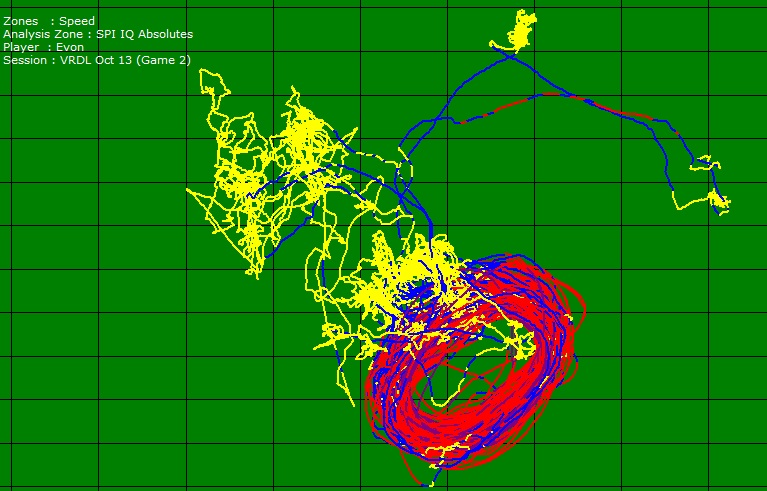
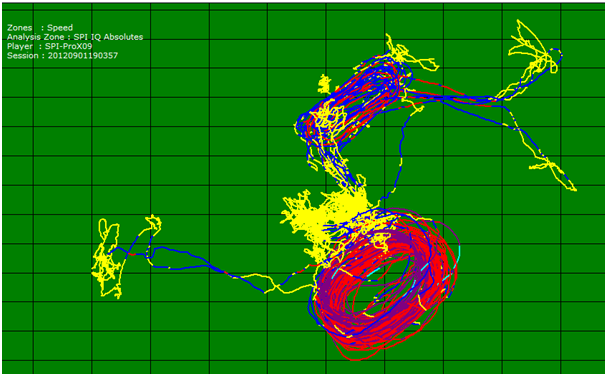
Pretty picture from Game 2 of GPS tracking.
I want to keep my initial analysis very brief after doing GPS at the VRDL Oct 13 Roller Derby bout in the Melbourne Showgrounds tent that allows GPS analysis. I will further dissect all this later with regards to impacts, G forces and perceived exertion ratings. What I also need is a work rest ratio of players and also what they did, block or jam.
Simply there were a few things that seemed to come out of this:
1. Length of warmups and lack of intensity in warmups. Just odd. Low intensity, high volume warmup. No accelerations, speed etc.Everyone does it so probably just become norm but doesn’t make a lot of sense.
2. Heart rate differences between combo blockers/jammers versus mainly jammers. Inference here is that Jammers are almost exclusively a power, high level anaerobic sport ( unless every jam went for 2 minutes non stop!).
3. Blockers may ( I say may!) have to be more aerobic and stronger. Just like front rowers in rugby union. Slow speed but constant motion. Throw that out there. Sort of robbing Peter to pay Paul when creating too many combo players. But of course this all relates to numbers in teams, penalties etc. Simplistically so far there is a trend and this trend relates o how you would train people.
Leave it there for now. I will download a few pretty tables & graphs and then analyze the data in depth plus stats from games and who did what. In a week I will provide a more detailed analysis aligned with stats and work rest ratios from games. Just need another set of data more so of blockers.
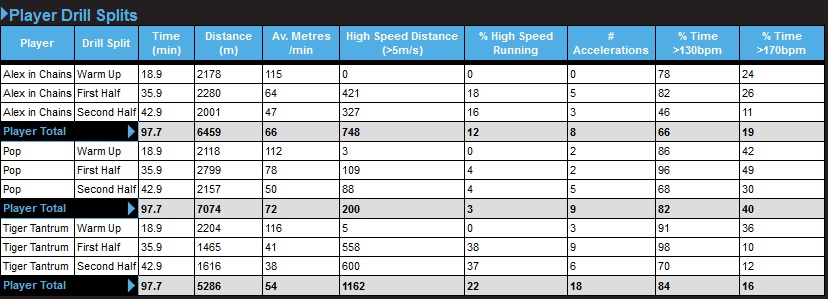
Below is a simple analysis. Speed is above 5 msec and accelerations are above a certain level. Pop mainly blocked.
GAME 1
GAME 2
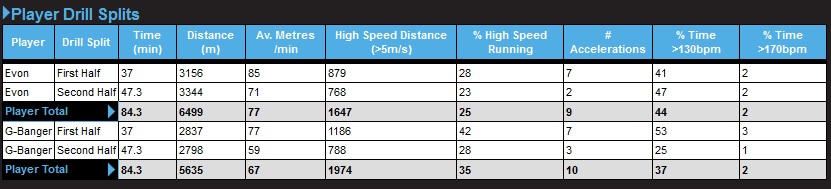
Note Skate only jammed in GAME 2 and lower heart rates.
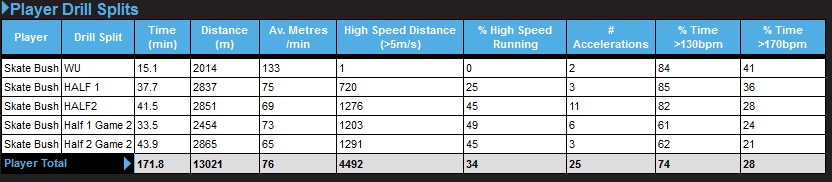
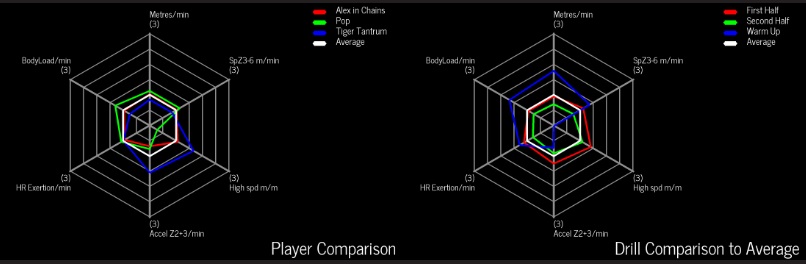
And here is a pretty graph!
Personal Trainers: Opportunities at Advanced Athletes Performance Preston
We are looking for 3 switched on Personal Trainers that are interested in running their own businesses at our High Performance Centre – Advanced Athletes Performance – in the inner melbourne suburb of Preston.
An ability to run your own business from our Centre as a licencee. Rent free period to build your business. Plenty of qualified leads straight away. If there are trainers sick of working in Parks & out of the boot of their car or don’t have enough $$ for all the required equipment or need a real home for their clients to train in all weather conditions……this could be for you.Have the added motivational advantage of training clients amongst Olympians & Elite sports stars.
-
Contact me directly on:
piero@AdvancedAthletesPerformance.com
Fitness, Sports Science,Socceroos and FFA. Optimal Preparation?
Hopefully our Socceroos win their home games and qualify. So important for the sport and they should be good enough to do that. Interesting to follow through how the young German team has used Athletes Performance in the US for their fitness program and how we have dismantled ours since the Hiddink, Dutch invasion.
Athletes Performance, Football and Wall Street Journal!

In the past few years we have seen most of our junior teams not make it through to competitions such as Olympics and World Championships. We have seen the development of soccer specific fitness mantras since the Dutch revolution invaded OZ Soccer post Hiddink. There is no doubt that we do not have the pool of technically gifted players in Australia. But what we did have was a powerful AIS and institute program which prepared players physically far better than traditional Football nations do. This has been dismantled and the mantra is do it with the ball. That simplistically makes sense but development is stifled when this approach takes place. In the end Nations simply pick their best players for teams. And the reasons for being selected are multifactorial. Technical & tactical nous, experience at high level, proven products, speed, agility, power & endurance and so on.
Our one advantage over other nations in my opinion was that we were bigger, faster, stronger and nastier, not better players or more skillful teams. Interesting comments below from Shad Forsythe who talks about the traditional nature of training in Football. And very odd that European nations would use a US company! Plus look at the age of German Team. Something for FFA to think about. Should have they had a comprehensive Skills and Fitness program in place since Hiddink? Not just Skills?
I think the questions now have to be raised about Verhajen’s influence and the Dutch influence on a Fitness program ( not technical/tactical skills) that was ahead of the world. We were producing fit, tough players. His concepts are simplistic, obvious and geared towards preparing a mature, skilled team. Not development.
Brisbane Roar is a terrible example for OZ Soccer. A diluted A league with few teams and lowish standard should not be used as an example of a Soccer Specific fitness program. Also many overseas and older players with mature bodies confuse this approach.
I think the FFA has to critically look at the one advantage we had in Australia in football. Fitness and Sports Science. Soccer is probably NO 4 sport in OZ. We do not have the talent pool that a country like Holland or Brazil does. Kids do not go to bed with their soccer ball. But we have a great country where kids play heaps of sports and lots of good weather. Just tough, fit kids! Let’s make sure we take advantage of our sports mad country and also AIS/Insititute and Sports Science expertise.
With the current FFA policy for fitness, development of young players is stifled and so many young players are poorly developed physically at young ages and will not progress. Talented and Skilful players will in fact be lost in the process because they lack physical ability. A paradox ( if that is the right word!).
Read the articles below. And realize how many AFL clubs use the same facilities in the US. Maybe we have been Gus “Hoodwinked”.
From Wall Street Journal Article, Shad Forsthye , Athletes Performance fitness Guru for Germany.
28 Jun 2012 – “Soccer is behind the rest of the traditional sports when it comes to fitness,” said Shad Forsythe, the Athletes‘ Performance specialist. d appearances made by Italy’s squad.
“Even though Germany’s squad is the youngest at Euro 2012, with an average age of just 24 years and 11 months, the German players have made a combined 835 appearances for the national team, almost 40% more than the 610 combined appearances made by Italy’s squad
Germans Mobilize the Pace Corps – WSJ.com

The “fitness arms race” in Australian Rules Football. Is it justified?
There has been an amazing amount of press about fitness gurus in the AFL recently. Obviously the saga at Essendon Football Club with Dean Robinson and the injury rate has created heaps of discussion. Now we have the rush to get the services of Darren Burgess, who is currently at Liverpool. Rumours surround the signing of Michael Malthouse and possibilities with David Buttifant from Collingwood. Western Bulldogs signed Bill Davoren a few years ago who was head coach for the AIS Triathlon Program. Guru status often gets bestowed on whoever wins the finals series. Clubs are jostling for the next panacea in Sports Science. I don’t want to comment on the competencies of fitness staff and individual decisions. Tough gig AFL and many good people involved. ( Maybe not gurus!) Just the business practices ( or lack of) and often total lack of scrutiny with CV’s etc. Often very smart business people on Boards throw out all their objectivity when involved in sports such as AFL and jump on the percpetion based, panic buying, profile chase to keep fans and media and stakeholders happy for another year. Then hope with fingers crossed that they will make finals!
Darren Burgess Liverpool Fitness to AFL again! $350,000 plus?
It is difficult to know what a club like Essendon spent on fitness in 2011/2012? But huge amounts! Winners are grinners. Do well & justified! Thats life.
Only as far back as 2003 at Geelong pretty much the fitness budget would have been 140/150,000 tops for all staff. Maybe 10,000 approx for equipment. The odd consultant. Wee bit of sports science money, maybe 10 to 15,000 max…I cannot remember exact amounts but simply not a lot. Anyway that was the key period for the development of the super Geelong Team of 2007 onwards. How did I manage it? Simply paid heaps of part timers small amounts to oversee varied functions. Mark Spivey was F/T but on a low wage and Chris Dennis was very much part time. Tahi Reihana received next to nothing to help with weights and tackling and same with John Minns in the gym. Then I had a yoga teacher come in and varied consultants like Mark Sayers pop in for very lowly paid consultancies. There were a few other small gigs and some work experience students doing odd jobs. OK different era but by 2006 the job was almost done with this team.
Now there is a rush to not miss out. But is best “business practice” and “Sports Science practice” being observed.
How many of these gurus have coached over long periods? Decades? Have they just slotted into transient positions and fell into well organized clubs and more so developed and talented elite athletes. In the end coaching is the key component , not Sports Science.
Are some of these very inexperienced Football Managers not doing due diligence on scrutinizing past Coaching experience and simply making assumptions? Do these managers ( many who have never managed business or organizations of any relevance) understand the difference between Sports Science and Coaching? Are many just trying to hang onto highly paid jobs!
And by giving some guru massive salaries, who is going to do the work? Supervising Pilates sessions, weights sessions, pool sessions etc. Does the club then have to draw the line on accessing consultants for specific needs because a Guru has sucked the budget. Can the club afford a sprint coach and quality massuers and simply expertise to underpin the multifactorial fitness and rehab needs of an AFL Footy Department.
My model would be to pay a competent quality person a good salary but leave heaps for lots of expertise in the fitness area so that all individual needs can be met. Spread the money. In the end it is the law of diminishing returns. For every extra 100,000 one pays a GURU one gets less and less value. Pay 195,000 a year and get a really really good person and have thousands left over.
Sports Science is critical and costs money, rehab experts and consultants are critical and should be called in on demand. Different periods of the year need different staff. Pay someone 200,000 and have 150,000 left over and wow get some amazing expertise out there. If an assistant deems themelves a guru and wants double then say ciao!
In a micro fashion that was how I operated. Training started at 2pm and at 12 30 all my part timers arrived and had specific gigs. And at 5pm off they went. We are talking elite operators.
But inexperienced managers get handed millions and then go for profile and perception to justify positions to Boards, the media and fans. And this approach works in the short term. But now we are seeing many failures since the mid 2000’s. Boards should ask staff to justify every cent. There is no panacea in exotic treadmills or amazing machines. Running on grass is the number requirement for an AFL fitness program. What is needed is Expertise and access to the amazing amount of varied knowledge that exists now in the Sports Science and Rehab Community. A guru cannot do it all. But a smart manager can access the best minds and then pull together a program but more so cater for the fine tuning needed. A football department now cannot do it all, let alone a guru. The next big thing is simply accessing people on demand.
I wrote a an article on if a possible model exists for success in the AFL. Certainly finances pay a part, as does talent, but there does seem to be a general model that can be adhered to. In fact Essendon and next Richmond represent ideal age structures to fit the model around.
Model for Success in the AFL. Does one exist?
I think Club Management and Accountants and CEO’s need to go through the rationales for buying equipment, panic hiring of “gurus” and indiscriminate “profile” based staff recruitment and objectively ascertain whether due diligence was adhered to.
But in the end winners are grinners so whoever wins will be copied. Odd when we are talking about a sport only played in a few states of Australia. So I do think the ARMS RACE is justified in AFL for fitness but beware the GURU and beware panaceas. The trick is how to spend the money and who is given the credit card!
GPS monitoring of Roller Derby VRDL vs SSRG. Initial data Physiological Status of Roller Derby
MEB-AAP Sports Science Consultancy
* Apologies to Calamity Maim who has been called “Main” below!
Last Saturday night the Victorian Roller Derby League All Stars played the Sun State Roller Girls at the Melbourne Show Grounds.
Myself, Peter Venticich and Liam Annett went to the Grand Pavilion and as the MEB-AAP Sport Science Consultancy Team] did a pilot study with GPS using 15 Hz [GPS Sports Trackers]. Luckily the signal transmitted through the tent at the Grand Pavilion which was a concern at the start of the night.
We tracked two [athletes]; Maim, a blocker and G-Banger, a jammer for VRDL All Stars.
Significantly, G-Banger was on 3 minors in the 1st half and was managed accordingly. Her 2nd half was more indicative of a normal jammer’s workload but she probably does more work in club meets and subjectively reported it as an easy night.
Maim also felt that due to the All Stars profile & simply the way the game eventuated, she had a lesser workload.
Before we give a snapshot of the GPS tracking we asked Maim and GB for their ratings of perceived exertion for the games which then can provide a subjective load estimate for loadings. Maim rated the game as a 4 on the Borg Scale (Somewhat Hard). GB’s rated it as 4 also. Thus if we guesstimate the warmup at 30 minutes and the halves at approximately 30 minutes each that is 90 minutes of work. So her Total Body Load subjectively is 360 units. So this GPS data must be viewed relative to the RPE loadings. With lots of subjective and objective data over time, plus fitness profiling we can slowly build a physiological profile for Roller Derby.
Thus using the RPE system, one can see if Maim rates a game at 8 (Very Very Hard) this would be 720 units. This obviously is a massive difference in load. It is important to gather RPE data to synch with objective data like GPS and Heart Rate or even lactate levels to then develop a physiological profile for a sport. You can then make sense of the data and then work out Work to Rest ratios in a game and interprations for physiological profile.
The other data we need is the girls maximum heart rate so we can assess what % of their maximum they are working at. Despite what most people think there is a plus or minus of up to 30 in max HR. So we need to beeper test all the girls with Heart Rate monitors on to maximum exertion to get that data!
Also notice that a few months ago I downloaded HR for Miss Chivas in a club game and her work rest ratios were less due to a combination of jamming & blocking. [Click HERE for this]. This rep game meant that there were more choices for jammers and blockers and thus more rest than work for most players. Also Roller Derby is a game where there can be huge variations each game due to tactics, penalties, availability of jammers etc.
Loadings for Sport using Ratings Perceived Exertion (RPE) Data
LOAD = Intensity * Volume = RPE * Total Time for Game=4 * 90=360 units
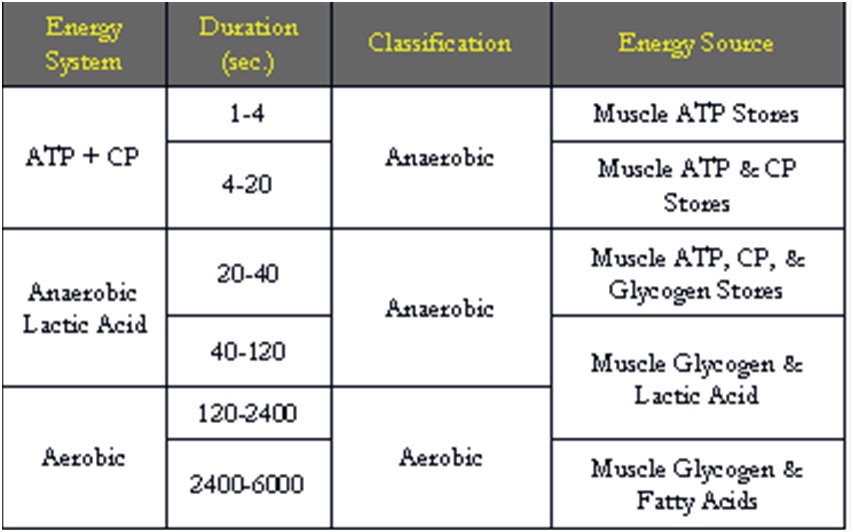
The issue also about whether the game is more anaerobic ( without oxygen) or aerobic is an interesting one. From the data with GPS we have, there certainly is a need to accelerate and decelerate for jammers. So the Alactic Anaerobic Energy system needs to be developed. And in general power and speed are premium qualities required for jammers.
But a jam can go for 2 minutes and the player if free can move at 100% for 2 minutes. By then the predominant energy system becomes aerobic and more so if there is only a 1 to 1 work rest followed by another 90 secs or 120 seconds jam, the player has to use their aerobic system to recover on the bench in time for the next Jam. So the sport is complicated and at the end of a close game, with penalties and injuries a jammer’s aerobic system could be the difference between winning and losing a game. So in reality it is an intermittent or repeat effort/repeat speed sport where power and speed are critical but at the other end of the spectrum aerobic energy systems have to be sufficiently developed to enhance recovery between jams. So simply an individual approach must be taken with training Roller Derby for fitness. Simply a needs analysis. So in the next few months we will try and create some physiological profile for the sport.
So below are two charts to show you how the energy systems interact and some indicator of how it could all work in Roller Derby.
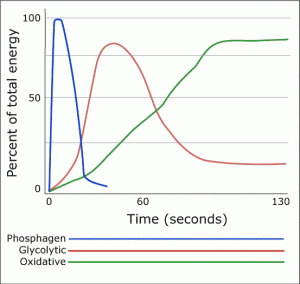
Oxidative is the aerobic energy system.
G-Bangers’s GPS Tracked Movement for Entire Game + Warm Up / Cool Down. The different colours are different speed zones.
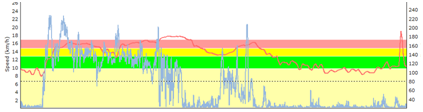
The Speed data in the graphs appears as blue lines as below and heart rate as red. Below is a few minutes of a jam and a rest. Obviously one can dump masses of data onto excel and then analyze it but the GPSports Software provides a nice package at first glance.
So lets look at some of the data but I think we need to do lots more GPS profiling and also fitness profiling as suggested of players.
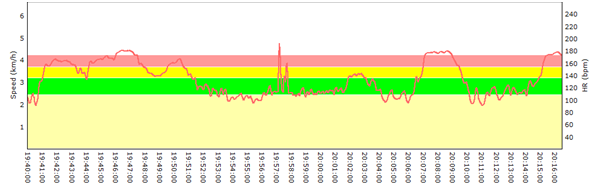
First Half for Jammer at VRDL vs Sun State Roller Girls. GB’s 1st Half . Max Heart Rate – 192 beats per minute. Average Heart Rate – 133 beats per minute * Middle section was time in penalty box
Second Half for Jammer at VRDL vs Sun State Roller Girls. GB’s 2nd Half . Max Heart Rate – 189 beats per minute. Average Heart Rate – 129 beats per minute * pretty soft night!
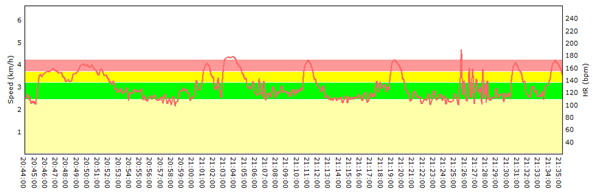
Maim’s 1st Half ( Blocker)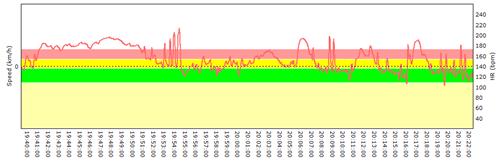
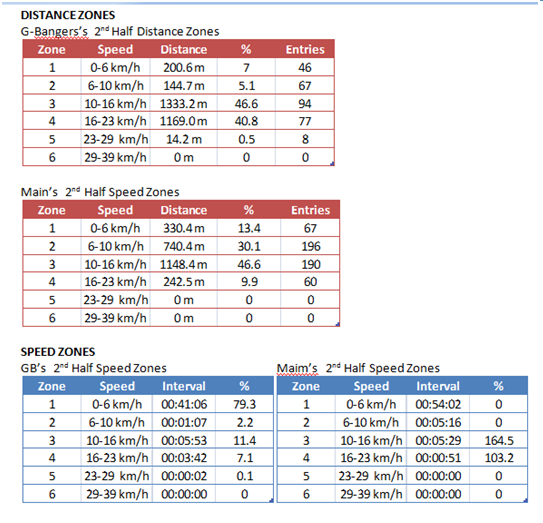
Now some of the speed data from GPS, plus distance travelled in speed zones.
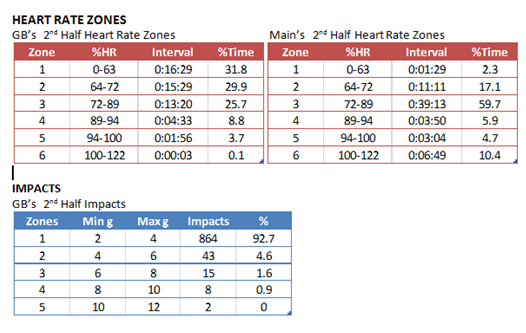
Below are the Heart Rate Zones but we simply need to know players Max HR’s before we make too many deductions. The interesting data below is the IMPACT data from accelerometer on GPS unit. In the 2nd half G-Banger had 2 10+ g force impacts. These are severe impacts so may have been falls or hits. So data needs to be synched with video or tagged.
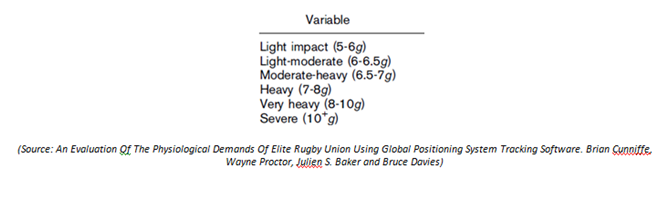
Below is a scale of impacts from accelerometers. So we just have to find out whether these are hits or falls?
Other data such as accelerations and decelerations ( important data) and total body load can be gleaned from data but above is just an example of how a physiological profile can be achieved. Work Rest ratios can also be assessed for games and obviously in games such as these, more players, penalties, time outs and so much can impact.
The obvious initial data suggests that there is a lot of acceleration/deceleration and surges. The RPE data and loads suggested a “soft” game for the players tracked. But the sport is intermittent. There are constant rests and in the perfect world it is 2 minutes on and 2 minutes off. Doesn’t work out that way but reality is that there is time to recover. But once we collect more data and look at how long jams were and what was done in them and whether blockers need rest then we can start creating a physiological profile.
But again look at the graph of the energy systems. Look at the interplay that occurs before 2 minutes and realize how different physiologically one game can be relative to another depending on numbers in team, penalties and tactics.
Ultimately aim is to be able to individualize training programs for players from the data for the sport of Roller Derby. Look forward to the next 2 bouts and lots of data!
Thanks again to AAP’s major sponsor for Sports Science Project MEB Foods and minor sponsor STAMBOS.


MEB Foods and Advanced Athletes Performance
* Apologies to MAIM: some of the charts have you as ‘main”.
Physical Development Geelong Football Club 1999 to 2006
A lot has been written in past week about the inability of Essendon Football Club to tolerate the loads imposed by a high intensity weights program similar to what Geelong was exposed to from preseason 2006/2007. But the problem is that little is understood on what underpins the base required to underpin an aggressive approach as has been reported. I am not privy to what was done at Essendon. Who knows except the inner sanctum. It may simply have been too much too soon of everything, not just weights. So Essendon is not my focus . But the concept that players have to be taken past limits ( as reported) is incorrect.
AFL players have to run repetitively at high intensity and that was the number one focus I had in the development of the Geelong list, built on a base of core stability, core strength, proper biomechanics and individual needs.
I was gone in April 2006. Terminated but not for fitness reasons. After Round 2 we flag favourite. I was gone after round 3! Prior to that we won the NAB Cup in Adelaide. Lost a close semi final in Sydney in 2005 with a young team. Lost a close Preliminary Final in 2004 again with a developing team. Physically the job was almost done by 2006. The team was ready to compete. Not the finished product because some of the players were still developing and also some needed time to mature IE Ablett. But a process had been in place with very few resources from preseaon 1999. My funds were obliterated in 1999 so till 2004 I operated on very little. I even had equipment donated by my brother in law Gus Puopolo! We made our own Pilates Reformer!
1999/2000 PreSeason
Many of the crop of players came to Geelong in this draft. We started a careful core strength/core stability program with these kids and a resolve to make sure they coped with pre season demands. The plan was approximately 30% of weights intensity & volume/ 50 to 75% running & 90% Skills and Games. But continuity was the focus IE of Skills Sessions, Games and then training. Also with Jarrod Egan I made sure every player was fully skilled in running drills and an array of gym techniques. We used Mark Sayers as a biomechanics consultant and screened every player running. My focus was education, creating a base and continuity of training. Very little power training was done given the mix of kids and oldies and we simple made sure every kid got a good base of specific core and skills work
2000/2001 Pre Season
Other players were drafted this preseason. We started progressing 99 drafts individually. IE Enright moved quicker than Corey for example. But the process was still about making sure that all players had developed a proper base of core strength and worked on individual needs. In the gym we moved with players like Scarlett given he was in his 3rd year but in general we stayed more with circuits, hypertrophy and specific needs. But the main focus became the ability to run at high intensity and also repeat it. Added to this I did a lot of Hill Intervals. We worked a lot on run technique, speed work at Landy Field and Repeat Hills at Eastern Park. This was a bigger focus for 2000/2001 & 2001/2002 preseasons. IE Developing efficient runners.
2001/2002
I started to move towards a performance enhancement model in this block but totally individualized. Players like Cameron Mooney were still in phases of rehabilitation after coming from Kangas with severe OP. The “kids” were still “kids” so it was in reality more of the same. The emphasis turned again to technical excellence in the gym, individual programs and also introducing agility and plyometrics. I got a 50m indoor track upstairs and did lots and lots of speed work there every week. This emphasis on max speed work, in close accelaration and agility was a focus. I employed Tahi Reihana to enhance contact skills and evasive work. Lots of core circuits, general training such as rowing and gymnastics work and ongoing development in the gym
2002/2003
With funds starting to loosen I had every player screened for core stability by Michael Dermansky, a physio. We had every player tested by ERA for Max VO 2. We employed John Minns ( shot putter) and more so Mark Spivey ( ex Decathlon) to our program. He went on to underpin the English Ashes wins! Also we employed Chris Dennis as a junior assistant. This is when I really sparked up the strength program. Every Saturday was Squat day and plyo day. We added explosive SLED training and contrast speed work. Lots of bounding. This was all done on a base of individualized programming given some players were still at STAGE 1 IE Core Stability etc. Also I started to do a lot more high intensity interval training sessions wit sessions such as 400/500/600/500/400 etc. But still the focus was continuity and injury prevention whilst pushing the DOMS envelope every week to create enough stress for adpatation. Very few young players were injured. We had a remarkably low soft tissue rate.
2003/2004
Simply a carbon copy of 2002/2004. Pre Xmas saw Spriggs, Ling, Steve Johnson pumping out some great interval work. Players like Scarlett were squatting big and running fast. I had started using GPS units in 2003 and with RPE loadings tried to make sure we were doing the right loads inseason. Once we got this right inseason we made the Prelims. Many of the players were starting to mature physically , but still young and needing games and experience. But we were able to compete physically with the Lions. Just not good enough.
2004/2005
Here we entered a more classical model where we had made the prelim, had some mature players, some young players and varied rehabilitation needs. Thus the focus was simply ongoing development and a commitment to producing players that could repeat effort, love contact and be explosive all day. Inseason was difficult. We started well. Had a high injury list midyear plus a young bunch who needed direction. I started PROJECT POWER midyear and focussed on lowering body fat, increasing leg power, upper body strength and rehabiliation. I had used Donna Rae Sazlinzki since 2002 with ergos and bought her in to get players fit by finals. We pulled out of a nosedive mid 2005 and nearly beat the eventual premiers in Sydney. This was a huge job for me and Chris Dennis but very satisfying.
2005/2006
The coaches decided to train less this preseason. Not the fitness staff ( Myself, Cameron Falloon and Luke Meehan) . This was a poor plan but I had to manage the program in a once a day format and 4 days a week plus Saturday AM. We had to mix Skills/Running and Weights in one session! We did our very best. Given we had better facilities and more staff for rehab and fitness we did do a lot of specific rehab work with players like Ottens and many others which was a huge plus this preseason. This very specific work underpinned the next few years in a few players that had been in rehab in 2005. Simply put the pre season was frustrating because we had less time to train players but we simply did the best we could in the sessions we had and many individual players still made gains in power, strength, fitness and speed. From a team perspective there was not enough time allocated. My gut feeling is that we could still have made finals in 2006 if the political situation had been more stable. But that is an opinion only.
Summary
By 2006 ( from 2001) we had half the AFL hamstring rate. Well below quads, on average for OP and slightly higher for calves. IE Our developing players had generally achieved continuity of games, skills sessions, running sessions and weights sessions in that order and priority. This is RAW HARD DATA. The emphasis had been on developing a team that could run repetitively and efficiently at high intensity. Then the next priority was contact specific Strength and Power Development. But all the time we made sure that all core stability issues and individual rehabilitation needs and recovery needs were always the NO 1 priority. The biggest predictor of getting an injury is having had an injury before, so avoiding injury is critical. DOMS is different. We always chased high eccentric loads in preseason to make sure players were immune to high intensity demands. Anyway blah blah. The Geelong team of 2006 that presented for preseason 2006/2007 had a massive base. And 5 finals with 3 finals wins and 2 NAB cup finals. Pretty good base! And the staff from then onwards did an awesome job!
The Real Josh Ross Story
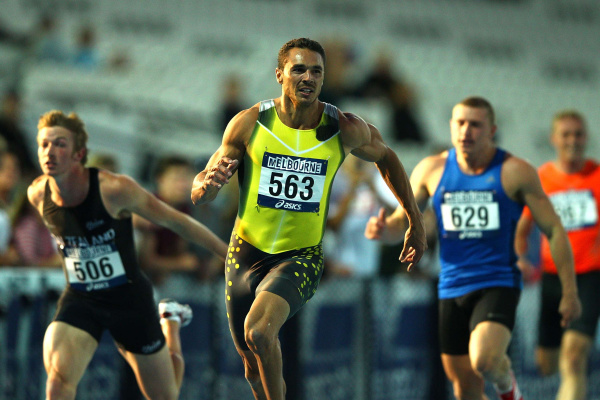
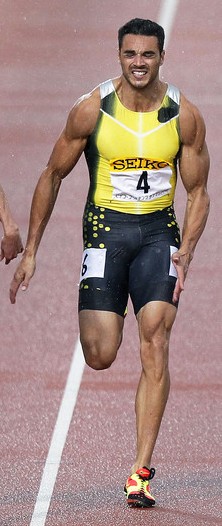
Unfortunate that so much negative press has occurred over some “words” a few days ago. Josh did say that he just wanted an explanation for omission from team. Probably the press release simply did emphasise the boycott issue but the pity is that Josh’s comeback has been remarkable. That has been lost. And with zero, zilch, nada backing from AA till the National titles and at 31.
After 2 years off ( almost 3! ) he ran 49 secs for a 400m in October 2011! Then a 21.5 in interclub club against some kids. Then won Zatopek 100 yards on a wet night. He then hit form in a PRO gift in Queanbeyan with a 12 3 off I think .5m. He continued this form into Bay Sheffield and Burnie but by Xmas had an injury from running too fast, too often over 3 gifts without a base. But it was obvious he could still run fast.
So January was a wipeout and rehab was the issue most of the month. He ran one gift sore and that was it. His body was just adapting to high speed
He then was told he had to race in Adelaide and Melbourne ( Olympic Trials) to be up for selection in London. He ran the B Race in Adelaide and won. Money had to be found for this trip. He then went to Sydney and hit rock bottom off a poor January and came back to Melbourne where he scraped into the final of the Trials with a slow 10 8. Improved to 10 5 in final but was way off hitting form.
We then chatted to Adam Basil, and Piero Sacchetta ( his coach now) then Piero supervised every session and massaged him and managed him day in and day out. He flew to the NSW titles and won in 10 4 ( 2*10 4’s) but more so was getting good food and training in. Time trials over 60m were starting to improve and I watched a session in March where I could see him hitting form again.
Piero was at every session and it was decided to not run after NSW and put emphasis on the Nationals in April. The wind was swirling that night and after a few false starts he easily won in 10 23 vs 8 headwind. IE .05 off A qualifying.
He then went to Canberra on a cold night and had a very minor adductor strain in the warmup a week after Nationals. Just started chase for A Qualifier. Piero went to every race and one has to remember that Athlete and Coach funded these trips. Caroline Wilson totally forgets that athletes like Josh struggle to afford spikes. And what happened in the mid 2000’s with Josh and AA/coaches etc should be in the past. One wonders?
2 weeks rehab and Piero and Josh paying for physios and rehab, Josh was ready again and ran a 10 16 windy in Japan.
After that they simply chased races on The Gold Coast and in Taiwan. Josh ran 10 3 and 10 4 many times and just could not get good conditions. My opinion from the A Qualifier perspecive is that he should have gone to Europe to chase a time and left the relay team to hopefully qualify. But his main emphasis became the relay team in the end and this was almost ruined by a planning disaster in Taiwan. All the relay runners were allowed to run the Individual heats of the 100m. But from what I have been informed, there was a ruling that you could not pull out of the heats/semis etc , otherwise you were out of the relay. So many of the OZ team ran the final ( should only have been Josh given he was close to A qual) and then straight after finals they ran relay and ran poorly. So there was a risk the relay team would miss let alone Josh not getting an A qualifier. Bit of drama!
Josh then chased more races in OZ and ran even in Canberra on a cold night in winter and repeated 10 3 3 times! Team then went back to Japan to make sure they qualified in Relay and Josh did his part for OZ by smashing the field in the last leg and the team was thankfully in the top 15 teams and in the games.
Josh then goes to England and dying to prove he is capable of running low 10’s IF he gets a gig in individual. Piero and Josh were still hopeful about this. From my perspective when the AOC provisionally selected Steffenson as a reserve against AA’s wishes Nick Green didn’t have a leg to stand on. Goalposts had been dug out and chopped up. Why wouldn’t you be desperate to run in Games IF you knew you could beat up people?
I am not going to comment on the fiasco that has occurred with selections and AA and AOC but simply the goalposts changed a million times. BUT Josh could have been provisionally selected in the team as a B qualifier and they could have sat on the decision till now. Piero was always in 100% contact with AA and did everything humanely possible ( and financially) to make sure Josh was 1. Running at his peak for the games & relay 2. Did the right thing by AA from January 2012 onwards. There was little avenue or time frames for appeals.
So it is quite obvious that Josh has stabilized form after 10 23 against a wind in Italy. He has run hard for 2 months so is in form and has repeated 10 3’s against kids in OZ in winter! He is a proven big time performer when in shape. He has done the right thing by the selectors from February.
So the bloke is just desperate to run the Individual 100m and if he was given a chance, bar a false start etc, would have progressed in rounds. At 31 he is out. Did he really say something stupid on Twitter or flash his pee wee on the Web? No he simply is desperate to run hard for himself and his country.
Does he get rich from running. No. Lets keep the media in perspective and the whingeing comments down.
He won’t beat Usain Bolt but he is the best 100m runner we have and would be the best in many nations.
THE JOSH ROSS STORY plus Advanced Athletes Performance!
This is a story on Josh Ross and his comeback to win his 6th national title this year and make the London Olympic Team. More so it is a reflection on the effort required to achieve this in a sport such as Track and Field in Australia. My business partner Piero Sacchetta has put in a massive effort to underpin this result and hopefully it ends in the future in sub 10 seconds performances.
Saverio Rocca lunging at Advanced Athletes Performance Preston

Saverio Rocca is seen at Advanced Athletes Performance in Preston, Australia, doing some tough lunges with son Marcus. Sav trained with us again this year after a block of training in 2011 also prior to year one with Redskins. My dad, George Bertolacci coached Saverio in athletics before Sav went on to kick 700 plus goals in the AFL. Saverio was a champion discus and shot put thrower and also could high jump over 190 when over 100kgs.
Great to have him at the centre now, doing his preseason work and also a fantastic role model for our young athletes.
 loris bertolacci