Are Intermittent Fitness Tests like YOYO Redundant?
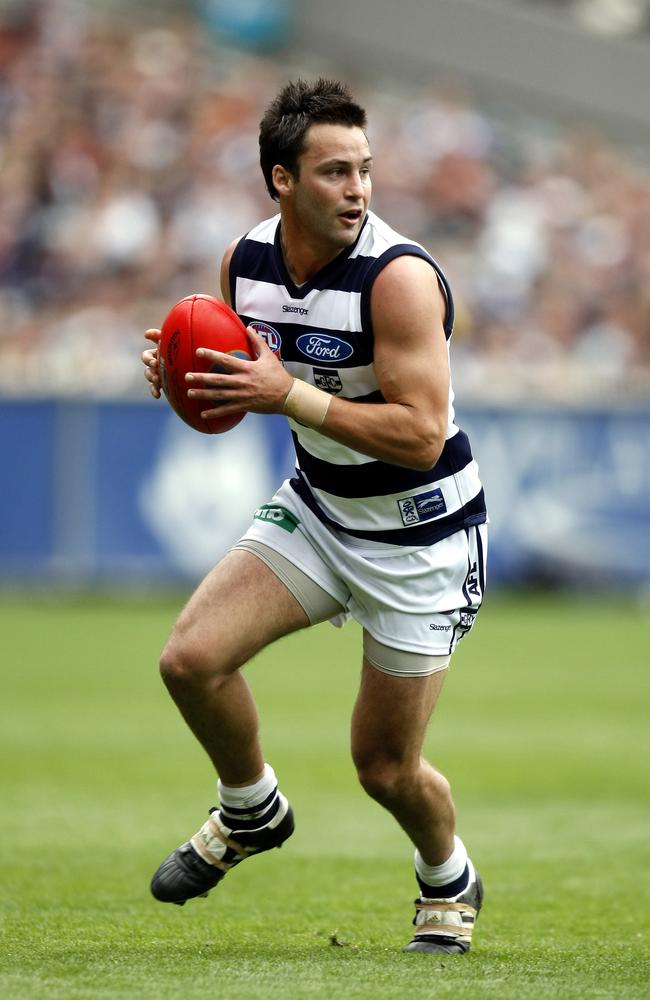
I once read about a term called the “Queen Mary Effect” in athletes. This refers to a player who has adequate or even good aerobic fitness but struggles with change of direction, resulting in poor performance in tests like the beep test, Yo-Yo test, or any intermittent fitness test involving frequent changes of direction. Jimmy Bartel was an example of such a player. In 2023, as a young athlete with huge potential, his coaches deemed him unfit during competitive games, despite his promising performances. Subjectively, this conclusion was supported by his fitness test results: a beep test score under 13 which was poor. Despite a 3km time of well under 11 minutes, and a VO2 max in the mid-50s—sufficient to suggest he could develop the “repeat speed” required for his sport. Additionally, his 20m sprint times were 2.99 and 3.02 seconds. He was not “fast” but in a straight line did ok.
The fitness staff noticed the coaches implementing a lot of shuttle runs and additional running drills, which raised concerns. We decided to conduct a more detailed assessment.
We introduced the following tests:
- The NFL 5-0-5 test.
- A modified 180-degree change-of-direction test (left and right).
- Vertical jump tests.
- Multiple single-leg hop tests.
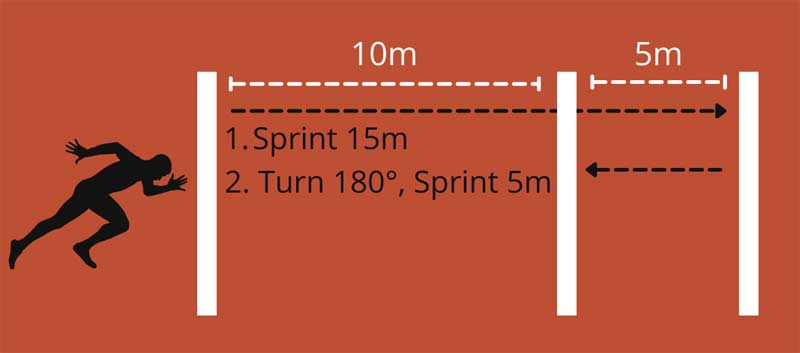
The results revealed significant deficiencies in leg power. His single-leg hop test results were well below norms, and his change-of-direction tests were poor. In summary, he struggled with changing direction efficiently.
This explained his poor beep test performance. Every turn during the test resulted in an energy leak, and he displayed inadequate acceleration after each change of direction. Cumulatively much slower each 20 meter segment. Plus more fatigue due to lack of eccentric efficiency.
After six weeks of focused power training, we re-tested him. His beep test score improved to over 14, and his in-game performance demonstrated noticeable improvement. Importantly, his VO2 max and aerobic threshold hadn’t changed, indicating the improvement was purely due to enhanced power and change-of-direction ability.
This experience led me to question the relevance of intermittent fitness tests like the beep test and Yo-Yo test for team sports. These tests seem to have too much “noise” to accurately measure fitness.
Pure aerobic tests can tell us about an athlete’s base capacity, while power tests provide insights into their ability to change direction and apply aerobic capacity effectively in specific scenarios. However, the issue arises with outliers:
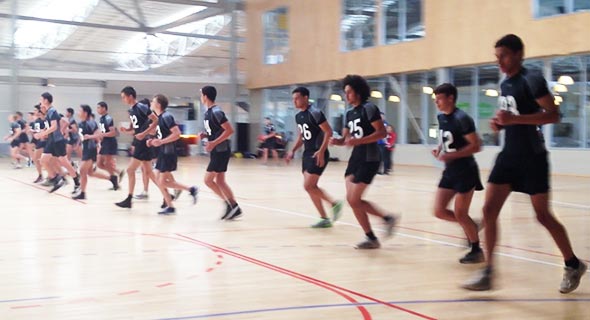
Players with strong aerobic fitness but poor change-of-direction ability often perform poorly on intermittent tests due to inefficiency in turning.
Conversely, powerful players may mask their poor aerobic fitness by excelling in change-of-direction tasks.
Players who sit in the middle likely have intermittent test results that correlate with their aerobic fitness.
My estimate is that a minimum VO2 max of 52 is required to play AFL effectively. By combining aerobic fitness data with power and change-of-direction tests, we can gain deeper insights into an athlete’s profile.
However, I question the necessity of these combined tests, such as the beep test, Yo-Yo test, or 30-15 Intermittent Fitness Test, given their variability and potential lack of specificity for team sports.
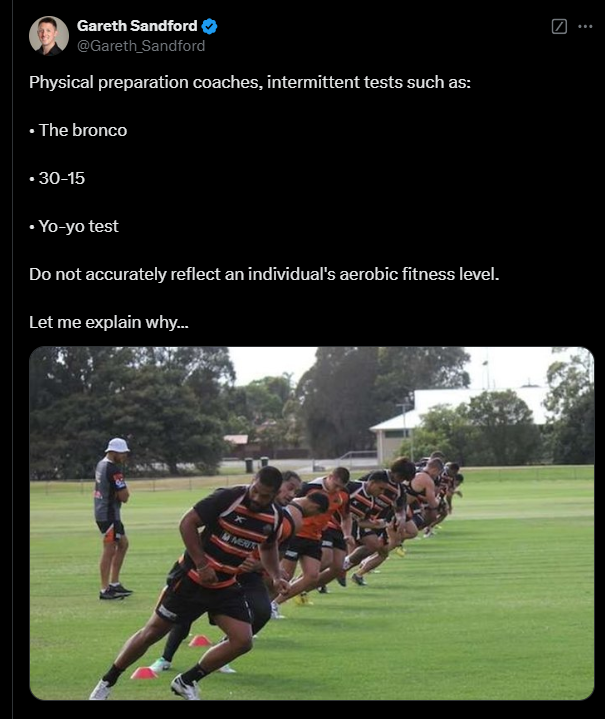
Gareth Sandford has been doing a great job bringing these issues into focus in training and testing team sports.
https://twitter.com/Gareth_Sandford/status/1671534198945988609
The “fitness arms race” in Australian Rules Football. Is it justified?
There has been an amazing amount of press about fitness gurus in the AFL recently. Obviously the saga at Essendon Football Club with Dean Robinson and the injury rate has created heaps of discussion. Now we have the rush to get the services of Darren Burgess, who is currently at Liverpool. Rumours surround the signing of Michael Malthouse and possibilities with David Buttifant from Collingwood. Western Bulldogs signed Bill Davoren a few years ago who was head coach for the AIS Triathlon Program. Guru status often gets bestowed on whoever wins the finals series. Clubs are jostling for the next panacea in Sports Science. I don’t want to comment on the competencies of fitness staff and individual decisions. Tough gig AFL and many good people involved. ( Maybe not gurus!) Just the business practices ( or lack of) and often total lack of scrutiny with CV’s etc. Often very smart business people on Boards throw out all their objectivity when involved in sports such as AFL and jump on the percpetion based, panic buying, profile chase to keep fans and media and stakeholders happy for another year. Then hope with fingers crossed that they will make finals!
Darren Burgess Liverpool Fitness to AFL again! $350,000 plus?
It is difficult to know what a club like Essendon spent on fitness in 2011/2012? But huge amounts! Winners are grinners. Do well & justified! Thats life.
Only as far back as 2003 at Geelong pretty much the fitness budget would have been 140/150,000 tops for all staff. Maybe 10,000 approx for equipment. The odd consultant. Wee bit of sports science money, maybe 10 to 15,000 max…I cannot remember exact amounts but simply not a lot. Anyway that was the key period for the development of the super Geelong Team of 2007 onwards. How did I manage it? Simply paid heaps of part timers small amounts to oversee varied functions. Mark Spivey was F/T but on a low wage and Chris Dennis was very much part time. Tahi Reihana received next to nothing to help with weights and tackling and same with John Minns in the gym. Then I had a yoga teacher come in and varied consultants like Mark Sayers pop in for very lowly paid consultancies. There were a few other small gigs and some work experience students doing odd jobs. OK different era but by 2006 the job was almost done with this team.
Now there is a rush to not miss out. But is best “business practice” and “Sports Science practice” being observed.
How many of these gurus have coached over long periods? Decades? Have they just slotted into transient positions and fell into well organized clubs and more so developed and talented elite athletes. In the end coaching is the key component , not Sports Science.
Are some of these very inexperienced Football Managers not doing due diligence on scrutinizing past Coaching experience and simply making assumptions? Do these managers ( many who have never managed business or organizations of any relevance) understand the difference between Sports Science and Coaching? Are many just trying to hang onto highly paid jobs!
And by giving some guru massive salaries, who is going to do the work? Supervising Pilates sessions, weights sessions, pool sessions etc. Does the club then have to draw the line on accessing consultants for specific needs because a Guru has sucked the budget. Can the club afford a sprint coach and quality massuers and simply expertise to underpin the multifactorial fitness and rehab needs of an AFL Footy Department.
My model would be to pay a competent quality person a good salary but leave heaps for lots of expertise in the fitness area so that all individual needs can be met. Spread the money. In the end it is the law of diminishing returns. For every extra 100,000 one pays a GURU one gets less and less value. Pay 195,000 a year and get a really really good person and have thousands left over.
Sports Science is critical and costs money, rehab experts and consultants are critical and should be called in on demand. Different periods of the year need different staff. Pay someone 200,000 and have 150,000 left over and wow get some amazing expertise out there. If an assistant deems themelves a guru and wants double then say ciao!
In a micro fashion that was how I operated. Training started at 2pm and at 12 30 all my part timers arrived and had specific gigs. And at 5pm off they went. We are talking elite operators.
But inexperienced managers get handed millions and then go for profile and perception to justify positions to Boards, the media and fans. And this approach works in the short term. But now we are seeing many failures since the mid 2000’s. Boards should ask staff to justify every cent. There is no panacea in exotic treadmills or amazing machines. Running on grass is the number requirement for an AFL fitness program. What is needed is Expertise and access to the amazing amount of varied knowledge that exists now in the Sports Science and Rehab Community. A guru cannot do it all. But a smart manager can access the best minds and then pull together a program but more so cater for the fine tuning needed. A football department now cannot do it all, let alone a guru. The next big thing is simply accessing people on demand.
I wrote a an article on if a possible model exists for success in the AFL. Certainly finances pay a part, as does talent, but there does seem to be a general model that can be adhered to. In fact Essendon and next Richmond represent ideal age structures to fit the model around.
Model for Success in the AFL. Does one exist?
I think Club Management and Accountants and CEO’s need to go through the rationales for buying equipment, panic hiring of “gurus” and indiscriminate “profile” based staff recruitment and objectively ascertain whether due diligence was adhered to.
But in the end winners are grinners so whoever wins will be copied. Odd when we are talking about a sport only played in a few states of Australia. So I do think the ARMS RACE is justified in AFL for fitness but beware the GURU and beware panaceas. The trick is how to spend the money and who is given the credit card!
Jarrod Egan from GFC to Celtic to Redbacks to Crows to Port!
Article late 2011 about Jarrod Egan, my assistant at Geelong from 1999 to 2003
http://www.adelaidenow.com.au/sport/afl/port-puts-one-over-adelaide/story-e6freco3-1226186648971
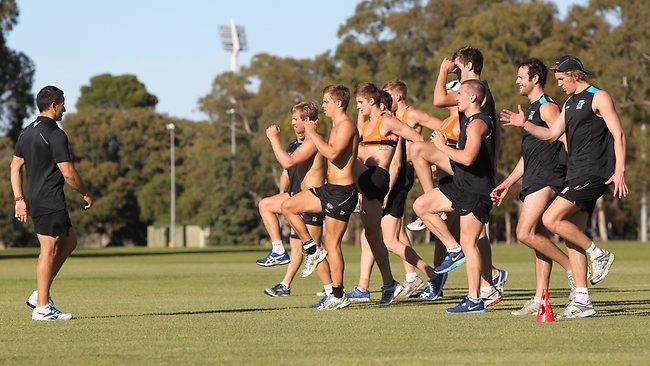
- by: Jesper Fjeldstad. From: Sunday Mail (SA). November 05, 2011 10:00PM
And the Power has confirmed it will venture overseas for a training camp this summer, heading across to New Zealand for what is expected to be four or five days some time in late November.Port Adelaide, which has been able to boost its football spend after a $9 million assistance package from the SANFL and the AFL, signed Egan to complete its most resourced football department in years and say he has already made an impression.
Egan was known by Port Adelaide fitness coach Cam Falloon because of their joint mentor Loris Bertolacci, the ground-breaking fitness coach who played part in the Baby Bombers’ 1993 success at Essendon and AFL’s first full-time fitness coach.
Falloon and Egan met over coffees and for regular catch-ups last year and when Falloon was told there was room to expand his department he didn’t have to think long before knowing whom to target.
Egan came with impressive credentials, having previously worked with North Melbourne, Geelong and Scottish Premier League soccer club Celtic.
As the Power embarked on a early morning session in the parklands yesterday morning, Falloon said the Egan investment was already beginning to reap rewards.
“He’s been a really good pick-up and what we’re really looking forward to adding to the fitness department is some experience,” Falloon said. “We’ve got some really good staff here with Andrew Rondinelli and Ben Serpell but we’ve probably lacked some experience.
“While we didn’t know each other well, we knew about each other and we had a few meetings last year, a coffee and a catch-up, and when the opportunity came up for us to recruit an experienced person he was certainly high up on our list.
“In a very short space of time Jarrod had been able to already make a very significant impact.
“We’re rapt with him.”
Then, in a cheeky manner, Falloon couldn’t resist to rub it in:
“And it’s always good to get someone from the Adelaide Crows.”
Fallon was also chuffed about the trip to New Zealand, which was about team bonding through hard work rather than high-altitude training – the time they will be away won’t be long enough to get the benefits of being in thin air.
“There are some fairly significant plans in place and it’s a really good opportunity to get the group together, work on team bonding and leadership and help the guys who are coming into the system,” Falloon said.
“Brad Ebert from West Coast Eagles and Brent Renouf from Hawthorn … it’s just a good opportunity for the guys to get away, do some hard work together and get to know each other.
“But also have a change of scenery. I guess what we’ve been able to do in the past few years has been to get away for a few days locally so this is a fantastic opportunity to head overseas.
“It’ll be a great thing for us as a group. With the clubs in the past, it’s had a really good effect in bringing the group together.
“It’s been a trend that when clubs do that they tend to have a really good year.”
Long Term Physical Development of Geelong Football Club from 1998 to 2006
There is heaps of confusion now in AFL fitness practices. 2 main areas of confusion are how to interpret GPS Data and also how big and strong should players be. The GPS situation needs to steady a little. The evolution of the technoogy has meant more precise data with better GPS units and more units. The rule changes have forced people to try and theorize about major changes in fitness needs. The biggest impact in fitness and AFL games has been the rotations. I saw the trend quickly early in 2005 when other clubs rotated and pushed rotations up as quickly as I could. Is every player now doing a 17 beep test now? Or a 22 YO YO test? Or bench pressing 150kgs? Players are leaner and overall stronger and fitter but physiologies havent evolved as much as people think. More how people are used and the mix is the key.
The danger has been that people have reacted to the GPS data too quickly and said “more steady state running this year = more fitness needed.” But at the same time people have said “we have to play contact footy so need to smash bodies.” Very confusing. Some still fantazise about running teams off their legs. I reckon Bangsbo is pretty right. Good test the YO YO . Add a repeat speed test, some power test and some basic weights data and then easy to profile players.
BRIEF SUMMARY OF GFC PHYSICAL DEVELOPMENT 1999 to 2006 April
Now I was gone from geelong in April 2006 when they were 3rd i think on the ladder and after 2 years in the finals ( 04/05) with young players. From 2007 onwards the club didnt miss a beat with their preparation, development and management with a flag in 2007.. But the reality is that in 2004 and 2005 the players who underpinned their great era had heaps of experience in finals footy and a few wins and heartbreaks. All required in the journey.
When I got to Geelong in 1998, Scarlett,King for example were elready there. Kingy already had done a lot of hard work whilst Matty was very skinny but showed great promise with speed and decision making. Wojcinski was drafted in 98 . So really that year ( 1999) in terms of specific physical preparation, it was a bit insignificant because Gary Ayres team was ageing and I simply tried to keep them on the park. Interesting that my assistant in 1999 was Matt Hornsby who then went to Port Adelaide and now Richmond. Basically I did a lot of core stability work and low level unilateral weight training and lots of recovery. Alan McConnell did a lot of small sided games in pxmas 1998 and I also did lots of crosstraining. Simply the whole exercise in 1999 was keeping people playing and also not pushing the envelope in the gym and on the track. Mid 1999 saw the financial crisis at Geelong and I had almost no resources from then.
In 1999 many of the crew that formed the base of 2007 on were drafted. Ling,Corey,Chapman,Enright and so on. That year ( 1999 /2000) was a mix of development of very young players and maintaining an old base of players that got the club to one final versus Hawthorn. My assistant that year was Jarrod Egan. Jarrod is now at Port Adelaide but from 2003 worked at the Kangaroos, then Celtic in Scotland, the Redbacks and Crows. He was a good track and field athlete and had worked under Vern McMillan at the VIS. Jarrod was great at showing technique both in the gym and on the track. We were very conservative with all the new draft boys and I also sent Jarrod to do his levels in Pilates. Thus we started slowly from the ground up in 99/2000. All the players were screened and the main focus was that any areas of imbalances or core stability/strength issues were addressed. Then all the young players were taught all the different running and agility drills plus technique development in the gym was a critical part of the Program. By 2000 I was aware that the average age of a good team was 25 and nothing has changed. And all my experiences with players from Gary O’Donnell to all the Baby Bombers then the Lloyd/Lucas era had showed statistically that it would take time.Added to this was the fact that in the 90’s young players were a year or two behind the current draft kids. So 2000 was simply again keeping old players on the park and nurturing and not breaking young babies.
The next crop of players started coming in over the 2000/2001 drafts. All of a sudden by 2002 there was a lot of pressure to succeed. But reality was the club was almost broke and full of kids. I knew we were in for the long haul. So preseasons 2000 to 2001 were a lot about building the base for the 1999 draftess and repeating the careful physical approach of preseason 1999 with newbies. One thing that I did with players in their second year was put running efficiency and speed developemnt at a premium. I also made the 2nd and 3rd year players do some hard work up the hills at Eastern Beach each pre season. Controlled and timed sessions such as 10*100m or 3 sets of 3 220m’s walk back. I did not rush their weights program in this phase. More important was a gradual build up of all athletic skills with strength and power and also a dedication to keeping players on the park so they could get lots of skill development & games played. The most important factor.
I repeated a camp I did with Essendon in 2000 and we went to the AIS for a week and exposed the players to elite training methods. Not Arizona but just as good.
So by the end of preeason 2002 all the young group had been privy to every conditioning technique and also exposed to some hard work. Not 5*1km stuff or LSD but repeated high intensity interval work and exposure to plyometrics and speed/change of direction and acceleration training. Stats in the gym were meaningless still at this stage. Technique was the aim and conditioning.
In preseason 2002 I employed Mark Spivey ( head lead ECB now) and Chris Dennis ( Paris Rugby Union Guru now). Also I got Tahi Reihana in from Rugby League and used John Minns in the gym. ( Ex OZ Shot Put record holder). My brother in law ( Gus Puopolo) donated Power Racks and weights because still the club was not spending. I also bought second hand weights and scrounged bits and pieces. Mark Spivey added a dimension of Agility Training to the program and also introduced week in/week out sleds and contrast sprints training. Seeing Harley and Hunt ripping sleds and sprinting was great. We also did more bounding and started an aggressive Power Weights program that pre-season. Spives went to the Bulldogs the next year and Chris Dennis took over as my assistant. Chris had captained Vic in junior basketball ( I think!) and he also was great in the gym and on the track. John Minns stood at the Squat Rack every Saturday morning for 2 years and we carefully put 2 good years of hard yakke into their legs and bums. I used Tahi Reihana in the gym but moreso to transfer the weights work into contact work and change of direction. Tahi did a lot of unheraled work with many of the young players. I also used Mark Sayers ( ex All Blacks Biomechanist) to assist me with inclose agility work and screening players for running technique and contact work.
So in preason 2002 players like ling etc ( add Carazzo!) were doing high intensity repeat 150’s with a minutes break and looking ominous. Repeating speed and grunt was the focus n a base of stability and technique. But there was always a commitement to making sure all the players had a great base to work off. Even players like Cameron Mooney had to spend a year getting problems like OP corrected after coming from the Kangas. And an Individual approach was taken as much as I could with the staffing I had.
So by preseason 2003 most of the players ( except the AblettG/Mackie) group were well on the way to be being powerful runners and inclose contact players. Gazza etc were again in a development situation due to age/low training age and simply not ready.I alsof the players after a few years of development. I tested every players MAX VO2 that year and had every player screened for core stability by Michael Dermansky. Thus I then knew the underlying physolgies. Enright and Ling were high 80 max vo2 adn even Ablett was above 60.Someone like Mooney was close to 50. Thus after years of testing speed and fitness plus wathing them play I had a better idea of what they could do on the park..
In the preseaon of 2003/2004 I changed training a lot. We prioritized Skills and tactical training and didn’t do specific running days as in the previous 2 preseaons. Running was done after Skills. One session was an aerobic bias , one was anaerobic and the Wednesday Run session was speed. But the push in the gym was still on and whilst being individualized, focussed on power and strength.I also employed Donna Rae Szalinzki to fine tune players with anaerboc needs on egros and had more funding and staff that year. Players were creeping up to 22/23/24 and starting to look like men. And play accordingly. Watching Ling. Steve Johnson and David Spriggs run that pre season was amazing. Unfortunately Johnson and Spriggs had accidents socially which meant their 2004 seasons were almost over. A pity because we went close in 2004. Awesome athletes.
The preseaon of 2005/2006 was a washout. A decision was made to only train once daily ( not mine!) and we crammed everything into one session and the review of 2006 demonstrated the inadequacies of that preparation. My hands were tied.
By that period and after a close call in the 2005 finals ( after a tough 2005) the players needed to be “topped” off. this happened in 2006/2007 pre-season and the finally the team got their reward.
So I started this bried history saying there is confusion in the fitness areas of AFL. Simply takes time to develop an athlete and AFL players have to run and jump and tackle repetitively. Pretty simple. They are not Sumo wrestlers or dustance runners.And if you rush development you can pay the price after. By 2004 or after 4 tears in teh system players were ready to win finals. Bot a flag.
Interesting that Decathlon in the 2000’s is really the trend that AFL fitness gurus whould examine. Add that to more Sports Specific Training & fitness related work. What trend is that or more so, what has changed in Decathlon in the last 10 years that leads me to that link?
Give me a buzz!
 loris bertolacci