GPS monitoring of Roller Derby VRDL vs SSRG. Initial data Physiological Status of Roller Derby
MEB-AAP Sports Science Consultancy
* Apologies to Calamity Maim who has been called “Main” below!
Last Saturday night the Victorian Roller Derby League All Stars played the Sun State Roller Girls at the Melbourne Show Grounds.
Myself, Peter Venticich and Liam Annett went to the Grand Pavilion and as the MEB-AAP Sport Science Consultancy Team] did a pilot study with GPS using 15 Hz [GPS Sports Trackers]. Luckily the signal transmitted through the tent at the Grand Pavilion which was a concern at the start of the night.
We tracked two [athletes]; Maim, a blocker and G-Banger, a jammer for VRDL All Stars.
Significantly, G-Banger was on 3 minors in the 1st half and was managed accordingly. Her 2nd half was more indicative of a normal jammer’s workload but she probably does more work in club meets and subjectively reported it as an easy night.
Maim also felt that due to the All Stars profile & simply the way the game eventuated, she had a lesser workload.
Before we give a snapshot of the GPS tracking we asked Maim and GB for their ratings of perceived exertion for the games which then can provide a subjective load estimate for loadings. Maim rated the game as a 4 on the Borg Scale (Somewhat Hard). GB’s rated it as 4 also. Thus if we guesstimate the warmup at 30 minutes and the halves at approximately 30 minutes each that is 90 minutes of work. So her Total Body Load subjectively is 360 units. So this GPS data must be viewed relative to the RPE loadings. With lots of subjective and objective data over time, plus fitness profiling we can slowly build a physiological profile for Roller Derby.
Thus using the RPE system, one can see if Maim rates a game at 8 (Very Very Hard) this would be 720 units. This obviously is a massive difference in load. It is important to gather RPE data to synch with objective data like GPS and Heart Rate or even lactate levels to then develop a physiological profile for a sport. You can then make sense of the data and then work out Work to Rest ratios in a game and interprations for physiological profile.
The other data we need is the girls maximum heart rate so we can assess what % of their maximum they are working at. Despite what most people think there is a plus or minus of up to 30 in max HR. So we need to beeper test all the girls with Heart Rate monitors on to maximum exertion to get that data!
Also notice that a few months ago I downloaded HR for Miss Chivas in a club game and her work rest ratios were less due to a combination of jamming & blocking. [Click HERE for this]. This rep game meant that there were more choices for jammers and blockers and thus more rest than work for most players. Also Roller Derby is a game where there can be huge variations each game due to tactics, penalties, availability of jammers etc.
Loadings for Sport using Ratings Perceived Exertion (RPE) Data
LOAD = Intensity * Volume = RPE * Total Time for Game=4 * 90=360 units
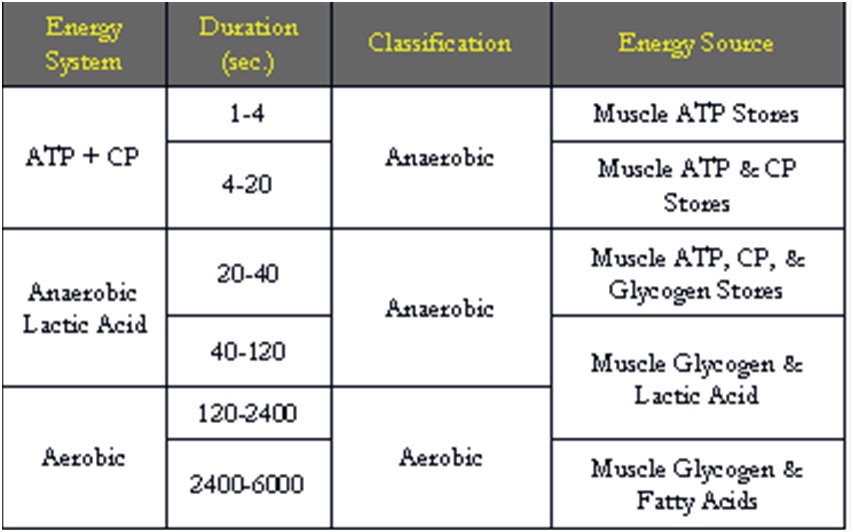
The issue also about whether the game is more anaerobic ( without oxygen) or aerobic is an interesting one. From the data with GPS we have, there certainly is a need to accelerate and decelerate for jammers. So the Alactic Anaerobic Energy system needs to be developed. And in general power and speed are premium qualities required for jammers.
But a jam can go for 2 minutes and the player if free can move at 100% for 2 minutes. By then the predominant energy system becomes aerobic and more so if there is only a 1 to 1 work rest followed by another 90 secs or 120 seconds jam, the player has to use their aerobic system to recover on the bench in time for the next Jam. So the sport is complicated and at the end of a close game, with penalties and injuries a jammer’s aerobic system could be the difference between winning and losing a game. So in reality it is an intermittent or repeat effort/repeat speed sport where power and speed are critical but at the other end of the spectrum aerobic energy systems have to be sufficiently developed to enhance recovery between jams. So simply an individual approach must be taken with training Roller Derby for fitness. Simply a needs analysis. So in the next few months we will try and create some physiological profile for the sport.
So below are two charts to show you how the energy systems interact and some indicator of how it could all work in Roller Derby.
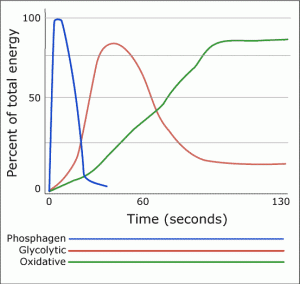
Oxidative is the aerobic energy system.
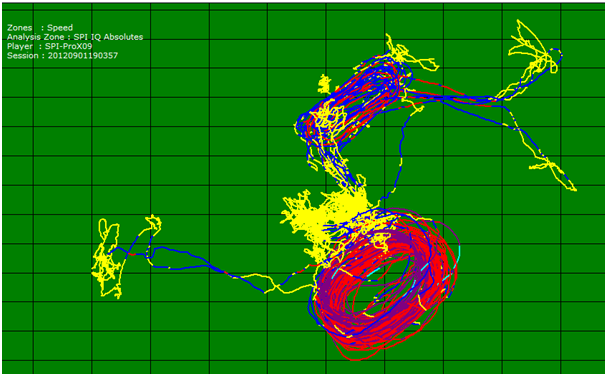
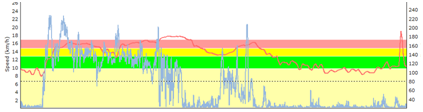
G-Bangers’s GPS Tracked Movement for Entire Game + Warm Up / Cool Down. The different colours are different speed zones.
The Speed data in the graphs appears as blue lines as below and heart rate as red. Below is a few minutes of a jam and a rest. Obviously one can dump masses of data onto excel and then analyze it but the GPSports Software provides a nice package at first glance.
So lets look at some of the data but I think we need to do lots more GPS profiling and also fitness profiling as suggested of players.
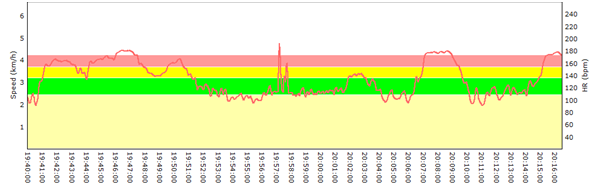
First Half for Jammer at VRDL vs Sun State Roller Girls. GB’s 1st Half . Max Heart Rate – 192 beats per minute. Average Heart Rate – 133 beats per minute * Middle section was time in penalty box
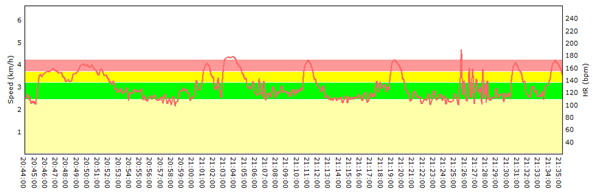
Second Half for Jammer at VRDL vs Sun State Roller Girls. GB’s 2nd Half . Max Heart Rate – 189 beats per minute. Average Heart Rate – 129 beats per minute * pretty soft night!
Maim’s 1st Half ( Blocker)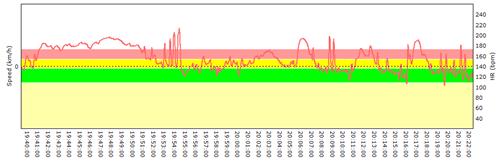
Now some of the speed data from GPS, plus distance travelled in speed zones.
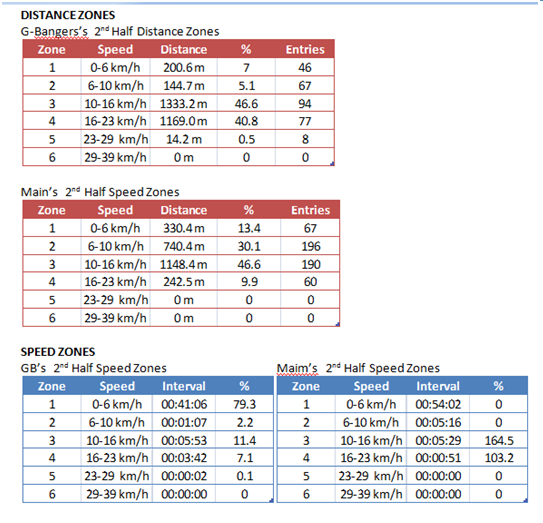
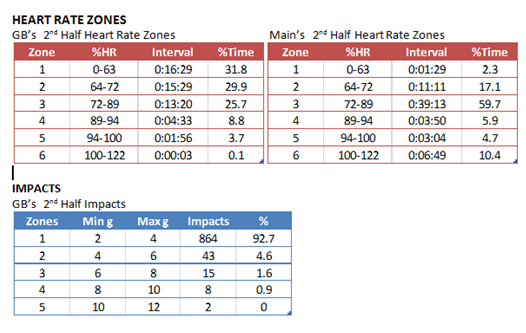
Below are the Heart Rate Zones but we simply need to know players Max HR’s before we make too many deductions. The interesting data below is the IMPACT data from accelerometer on GPS unit. In the 2nd half G-Banger had 2 10+ g force impacts. These are severe impacts so may have been falls or hits. So data needs to be synched with video or tagged.
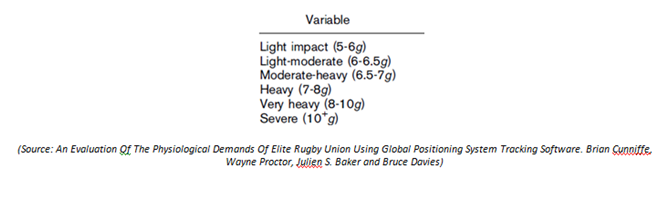
Below is a scale of impacts from accelerometers. So we just have to find out whether these are hits or falls?
Other data such as accelerations and decelerations ( important data) and total body load can be gleaned from data but above is just an example of how a physiological profile can be achieved. Work Rest ratios can also be assessed for games and obviously in games such as these, more players, penalties, time outs and so much can impact.
The obvious initial data suggests that there is a lot of acceleration/deceleration and surges. The RPE data and loads suggested a “soft” game for the players tracked. But the sport is intermittent. There are constant rests and in the perfect world it is 2 minutes on and 2 minutes off. Doesn’t work out that way but reality is that there is time to recover. But once we collect more data and look at how long jams were and what was done in them and whether blockers need rest then we can start creating a physiological profile.
But again look at the graph of the energy systems. Look at the interplay that occurs before 2 minutes and realize how different physiologically one game can be relative to another depending on numbers in team, penalties and tactics.
Ultimately aim is to be able to individualize training programs for players from the data for the sport of Roller Derby. Look forward to the next 2 bouts and lots of data!
Thanks again to AAP’s major sponsor for Sports Science Project MEB Foods and minor sponsor STAMBOS.


MEB Foods and Advanced Athletes Performance
* Apologies to MAIM: some of the charts have you as ‘main”.
 loris bertolacci
your gui on the gps should use addative filters to build nicer heat maps of the racing lines and speed. Do you get the raw data for the positions over time? If I get bored I could make one.
No probs Phil. I will tell GPSports of the impending developments if you have time & are bored, and of how to “tart” up the diagrams. Thanks mate.
I should also say: Nice work!
Thanks mate
I’m not a bio person, but this is really interesting. I’m not sure if it’ll matter or not, but the other thing you may want to take into account (which may not be easily done) is the difference in skating styles required for blocking and jamming. It’s not just movement and pure acceleration, but the positions in which you are being asked to achieve those movements, and at least in my case there is a significant difference in body requirements from that alone.
S’awesome work!
Thanks. Hopefully I can do about more analysis under the Grand Pavilion Tent with GPS before Xmas because this technology does not work under normal roofs. Then we can synchronize with video and GPS plus varied players and try and find out what the difference in skating styles/positions has on acceleration patterns and other data. Just takes time, staff and a bit of elbow grease!
Love this!!! As the fitness consultant for the Northern Brisbane Rollers, I have been wanting to further our development and look into how we can research and design our training. This has given me some great idea’s.. Thanks!
Hopefully in next 2 bouts I can get more data. The venue allows it due to tent like structure. Next year VRDL may not use venue as much. Then with fitness tests and GPS/HR data hopefully I can come up with more concrete guidelines for conditioning in the sport. Thanks
That’s awesome! I would love to hear how you go and I am very interested in the information that you come up with?? I will be sure to stay in touch!
Hi Loris,
Your research and entries about roller derby are really fascinating, Im really looking forward to how the profile unfolds. I’m a Sport and Leisure student in PEI, Canada working towards a Kin degree. I just started a contract to train our local roller derby team starting tonight. Wondering what gps unit you used to track the jammer?
I used GPSports 15 hz systems. The lucky break I had was that the facility the VRDL use is a massive tent like structure which allows for GPS. Indoors is normally a no no for GPS. Thanks for comments & good luck.
Unbelievable work. If you’d like more data collection, I’d love to try and replicate some of this with my league. I look forward to reading more of your results and suggestions.
Thanks Rebecca. Problem with GPS is you either have to be outdoors or like the Melbourne Showgrounds have a roof that allows thru signals. Very rare. Issue is also that VRDL will ,I think, shift to a normal indoor venue which will mean one cannot do GPS at all. Also the units I use are 15 hz units which at this stage cost a bit. Important for the sport that more data is collected and synched with fitness tests and of course skill ability. Then more objective conclusions can be made over how to train and who needs what and how to individualize.